

Marketing knowledge is everywhere — in books, courses, newsletters, and endless social media threads. Yet many marketers find themselves frustrated: they know a lot but achieve little. The gap between possessing marketing knowledge and using it well is wider than most people expect.
The real challenge is not acquiring more information. It is understanding when a specific principle actually applies to your situation, and how to activate it without wasting time, budget, or momentum. This article focuses on exactly that: the right moments to apply what you know, and the practical steps to turn marketing theory into real results.
What Marketing Knowledge Actually Includes
Before you can use marketing knowledge well, you need a clear picture of what it actually covers. Marketing knowledge is not a single skill — it is a layered collection of frameworks, mental models, and applied disciplines that each serve a different purpose.
Core Areas of Marketing Knowledge
- Frameworks and models — such as the 4Ps, STP (Segmentation, Targeting, Positioning), and Jobs-to-be-Done, which provide structured ways to analyze market problems.
- Consumer psychology — understanding how people make decisions, what drives action, and which cognitive biases influence buying behavior.
- Channel strategy — knowing when to use SEO, paid advertising, email, influencer outreach, or organic social — and why each works differently for different audiences.
- Data interpretation — reading campaign metrics with meaning, not just recording numbers and calling it analysis.
- Brand thinking — shaping positioning, tone, and long-term trust in a way that makes your business memorable and distinct in a crowded market.
Each of these disciplines has its own timing and conditions. Treating them as one unified body of knowledge — pulling any random framework for any random problem — is where many practitioners go wrong from the start.
When Marketing Knowledge Stops Being Useful
Marketing knowledge becomes a liability when applied in the wrong context. Recognizing these failure patterns early can save significant time and budget before resources are fully committed.
Over-Relying on Theory in Fast-Moving Situations
Classic frameworks were built for relatively stable market conditions. When your category is shifting rapidly — due to new technology, unexpected competitors, or sudden consumer behavior changes — spending weeks on a positioning matrix is far less useful than running fast, low-cost experiments. Theory should inform direction, not slow down action when speed is the competitive edge.
Applying B2C Logic to B2B Problems
Consumer marketing relies heavily on emotion, impulse, and short purchase cycles. Business-to-business selling involves multiple stakeholders, longer decision timelines, and ROI-driven justifications. Applying B2C tactics — like urgency-based flash promotions or lifestyle-driven messaging — to a B2B product often produces weak results. Not because the knowledge is wrong, but because the context does not match the method.
Chasing Trends Without Audience Alignment
Every year brings new platforms, formats, and buzzwords. Short-form video, AI-generated content, interactive experiences — all have genuine applications. But adopting a trend simply because it is popular, without first asking whether your specific audience actually uses it, is a reliable way to burn resources on activity that generates noise but not results.
The Right Situations to Apply Marketing Principles
Marketing knowledge delivers its clearest value in high-stakes, structured situations where a systematic approach directly reduces the risk of guessing wrong and committing resources to the wrong direction.
Launching a New Product
A product launch is one of the highest-leverage moments to apply marketing frameworks properly. Segmentation analysis helps identify who the product is actually for — not who you hope it is for. Positioning work ensures you communicate value clearly and distinctly against existing alternatives. Channel strategy decisions determine how you reach your target buyer at the lowest cost per qualified lead.
Repositioning a Brand
When a brand has drifted — when customers no longer clearly understand what it stands for or why it is different — structured knowledge about positioning, perception mapping, and messaging architecture becomes directly valuable. Repositioning is not a moment for intuition-driven guesswork. It requires methodical diagnosis of how the brand is currently perceived versus where it needs to be.
Diagnosing a Stagnant Campaign
If a campaign is underperforming and the root cause is unclear, applying a data interpretation framework — funnel analysis, attribution modeling, audience segmentation review — gives you a systematic way to isolate the problem. Without this structure, teams tend to change multiple variables simultaneously and lose the ability to understand what actually moved the needle.
Entering a New Market
Expansion decisions benefit enormously from structured market research, competitive landscape analysis, and buyer persona development. Moving into a new geography or vertical without this groundwork is one of the most reliable ways to spend significant budget without building lasting traction in the new space.
How to Translate Knowledge Into Decisions

Knowing a framework is not the same as being able to apply it under real business pressure. The translation step — from concept to concrete decision — requires a specific kind of deliberate discipline that most marketing education does not teach directly.
Match the Framework to the Problem
Not every problem needs the same tool. Start by clearly defining what type of problem you are facing. Is this a positioning problem? A targeting problem? A messaging clarity problem? A channel efficiency problem? Once the problem type is clearly named, the matching framework becomes far more obvious. Using the wrong framework on a real problem is one of the most common and costly sources of wasted marketing effort.
Test Assumptions Before Scaling
Marketing knowledge tells you what has worked in other contexts and for other businesses. It does not guarantee what will work in yours. Build in a structured testing phase before committing significant resources. Run a small pilot, measure it against a clear and specific hypothesis, and adjust based on actual results — not on intuition or what worked at a previous company.
Combine Data with Customer Empathy
Data tells you what is happening. Customer empathy — built through direct conversations, interviews, and observation — tells you why. The most effective marketing decisions combine both inputs. Relying solely on data risks optimizing for metrics that do not reflect real customer value. Relying solely on empathy risks producing work that resonates emotionally but fails to convert at scale.
Building a Habit of Applied Marketing Thinking
Applying marketing knowledge well is not a one-time project. It requires a sustained practice built into the rhythm of how you and your team operate week to week and quarter to quarter.
Run Regular Campaign Audits
Set a recurring review — monthly or quarterly — where you evaluate active campaigns against their original hypotheses. Ask honestly: Did we target the right audience? Did we choose the right channel for this objective? Did our message land the way we intended? This discipline prevents campaigns from continuing on autopilot long past their useful life while resources drain quietly in the background.
Involve Cross-Functional Perspectives
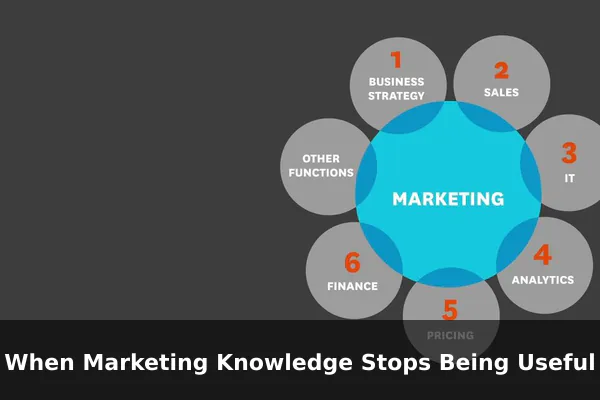
Marketing does not operate in isolation, and applied marketing thinking should not either. Sales conversations surface the objections customers actually raise — insights that should directly reshape messaging. Product teams understand feature value in ways marketing often undersells. Customer service interactions reveal the exact language customers use to describe their own problems, which is often more powerful than any copywriter’s instinct. Bringing these functions into regular marketing conversations turns knowledge into a company-wide capability rather than a department-level asset.
Treat Every Campaign as a Learning Loop
The most durable marketing knowledge comes from your own accumulated, documented experience — but only if you capture and revisit it deliberately. After every major campaign, write down what you assumed going in, what actually happened, and what you would do differently next time. Over time, this builds a proprietary understanding of your market and audience that no external course, book, or framework can fully replicate.
Conclusion
Marketing knowledge makes sense when it is matched to the right situation, applied with clear intent, and tested before being scaled. The practitioners who extract the most value from it are not those who know the most frameworks — they are the ones who know when to reach for a specific framework, when to adapt it, and when to set it aside entirely in favor of direct experimentation.
Use your marketing knowledge as a precision toolkit, not a universal script. Diagnose the problem first. Select the right tool second. Test your assumptions before scaling third. And keep the customer at the center of every decision throughout the process. That is when marketing knowledge stops being abstract theory and starts producing consistent, measurable results.
