
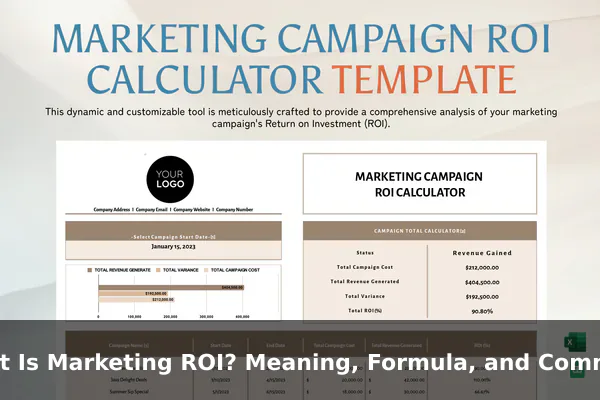
Marketing can generate traffic, leads, awareness, and sales, but none of those outcomes automatically prove that a campaign was worth the money spent on it. That is why marketers, founders, and business leaders rely on marketing ROI. It helps answer a harder question than whether a campaign was active or popular: did the investment produce meaningful business value?
If you have ever seen a campaign with strong click numbers but weak profit, you have already seen why marketing ROI matters. A channel can look successful on the surface and still waste budget if the revenue is low quality, margins are thin, or the total cost of running the campaign is higher than expected. On the other hand, a campaign with modest volume can be highly valuable if it brings in profitable customers efficiently.
This article explains what marketing ROI means in plain language, how the formula works, what costs to include, and the common mistakes that make ROI look better or worse than reality. The goal is not just to define the metric, but to help you use it well enough to make smarter budget decisions.
What Marketing ROI Actually Measures
Marketing ROI, or marketing return on investment, measures how much business return you get from the money you put into marketing. In simple terms, it compares the value created by marketing with the cost of generating that value.
ROI is about business return, not just marketing activity
Many marketing reports focus on activity metrics such as impressions, clicks, likes, open rates, or even lead volume. Those numbers can be useful, but they are not ROI by themselves. They tell you what happened inside the marketing process, not whether the process created profitable results.
That distinction matters because a campaign can perform well on early metrics and still fail commercially. For example, a paid social campaign may bring in inexpensive clicks, but if the audience is poorly matched, the landing page converts badly, or the resulting customers rarely buy again, the campaign may deliver weak or negative ROI.
- Vanity metrics show visibility or engagement.
- Performance metrics show actions such as leads or purchases.
- ROI shows whether the financial return justified the spend.
Why the metric matters for planning and accountability
Marketing ROI helps teams decide where to invest more, where to cut back, and where to test carefully before scaling. It is useful for both short-term campaign analysis and broader budget planning. If two channels generate similar revenue but one does it with lower cost and better margins, ROI reveals which option deserves more support.
It also improves accountability. Instead of defending marketing with broad claims about visibility or awareness alone, teams can connect spending to business outcomes. That does not mean every campaign must show immediate profit, but it does mean marketers should understand the expected payback and communicate it clearly.
A final point is important: there is no single universal good ROI benchmark. A healthy ROI varies by industry, business model, margin structure, sales cycle, and growth stage. A mature ecommerce company may expect fast payback, while a B2B software company may accept slower returns because contract values and lifetime value are much higher.
The Marketing ROI Formula Explained
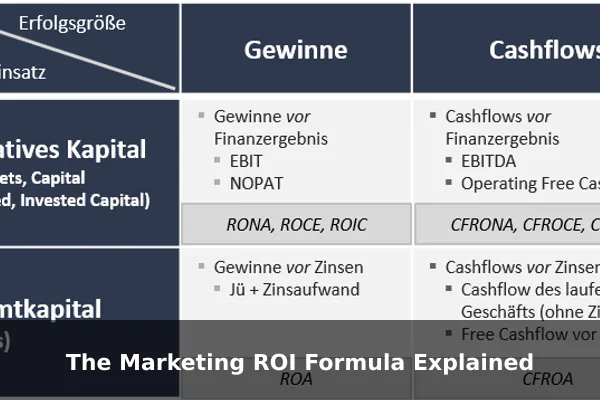
The standard marketing ROI formula is straightforward, but the quality of the answer depends on the quality of the inputs.
The standard formula
Marketing ROI = ((Return from marketing – Marketing cost) / Marketing cost) x 100
This formula shows the net return relative to the amount invested. If a campaign generates more value than it costs, ROI is positive. If it generates less value than it costs, ROI is negative.
To use the formula correctly, you need two inputs:
- Return from marketing: the value attributable to the campaign, channel, or marketing effort being measured.
- Marketing cost: the total cost required to produce that return.
Profit-based ROI versus revenue-based ROI
The biggest source of confusion is the word return. Some teams use revenue as the return number. Others use gross profit, contribution margin, or even customer lifetime value. Each choice can be useful, but they answer different questions.
Profit-based ROI is the stricter and usually better method because it reflects the real economic gain after accounting for the cost of goods or service delivery. If you sell a product for $100 but only keep $40 in gross profit, using the full $100 as return can make marketing look far more efficient than it really is.
Revenue-based ROI is sometimes used for quick reporting when profit data is hard to access. It can be acceptable as a directional metric if everyone understands its limitation, but it should not be confused with actual profitability.
- Use profit-based ROI when you want a more realistic picture of business return.
- Use revenue-based ROI only when margin data is unavailable or when you are comparing campaigns under the same margin structure.
- Use lifetime value-based thinking when the first sale is only part of the economic value, such as subscriptions or repeat-purchase businesses.
What the percentage really means
An ROI of 100% means the campaign generated an amount equal to the investment after recovering the original spend. In practical terms, every dollar spent returned the dollar back plus another dollar in net value. An ROI of 0% means the campaign broke even. An ROI of -50% means half of the invested amount was not recovered.
That is why ROI is more useful than raw revenue alone. A campaign that produces $20,000 in sales might look strong, but if it costs $19,500 to run, it creates very little economic value.
Simple Example of How to Calculate It
A worked example makes the formula easier to apply in real reporting.
Step-by-step campaign example
Imagine a company runs a one-month paid search campaign for a product launch. The numbers look like this:
- Ad spend: $3,500
- Landing page design and copy: $900
- Marketing software allocation: $250
- Internal team time assigned to the campaign: $350
- Total marketing cost: $5,000
The campaign produces 120 purchases. Each purchase is worth $150 in revenue, so total revenue equals $18,000. However, the company keeps only 60% of that as gross profit after product and fulfillment costs. That means attributable gross profit is $10,800.
- Calculate total return: $10,800 gross profit.
- Subtract marketing cost: $10,800 – $5,000 = $5,800.
- Divide by marketing cost: $5,800 / $5,000 = 1.16.
- Multiply by 100: 116% marketing ROI.
In this case, the campaign did more than pay for itself. After recovering the full marketing investment, it generated an additional 116% in return relative to cost.
How the answer changes when you use revenue instead of profit
If the same company uses revenue instead of gross profit, the calculation changes:
((18,000 – 5,000) / 5,000) x 100 = 260%
That number looks far more impressive, but it also hides a critical business reality: the company could not keep the full $18,000. This is why marketing ROI discussions can become misleading when teams fail to specify what counts as return.
For high-margin businesses, the gap between revenue-based and profit-based ROI may be smaller. For low-margin businesses, the gap can be dramatic. That is one reason retail, ecommerce, distribution, and service businesses should be especially careful with the formula.
A practical shortcut for regular reporting
If full profit accounting is difficult to produce every week, a useful compromise is to report ROI with a clearly defined return basis, such as contribution margin or gross profit, and keep that definition consistent across channels. Consistency matters because it allows you to compare campaigns fairly over time.
What Counts as Marketing Cost
Many ROI calculations fail because the cost side is incomplete. If you undercount costs, ROI appears healthier than it really is. A disciplined cost definition is one of the most important parts of accurate measurement.
Direct campaign expenses
These are the easiest costs to identify because they are tied directly to a campaign or channel.
- Paid media spend on search, social, display, or marketplaces
- Influencer fees, sponsorships, and affiliate commissions
- Creative production costs such as design, video, photography, or copywriting
- Landing page tools, form builders, and email sending fees
- Agency or freelancer fees linked to campaign execution
Internal and shared costs
These are often ignored, especially in smaller teams, but they still affect true ROI.
- A share of employee salary for time spent planning, launching, and optimizing the campaign
- Marketing automation, CRM, and analytics tools used to support execution
- Project management software and reporting systems
- Sales enablement support if the campaign depends on handoff and follow-up
Not every business assigns shared costs in the same way, which is acceptable as long as the method is reasonable and applied consistently. What matters most is avoiding a situation where one channel includes full support costs and another does not.
Commonly forgotten costs
Some of the most misleading ROI reports leave out expenses that are real but less obvious:
- Discounts or promotional incentives used to trigger conversion
- Free trial onboarding or implementation support
- Refunds, returns, or cancellation rates that reduce realized value
- Extra tools purchased temporarily for campaign execution
- The opportunity cost of pulling team resources from other high-value work
If you only include ad spend and ignore everything else, you are not measuring marketing ROI. You are measuring a partial media efficiency number. That can still be useful, but it should be labeled honestly.
Common Mistakes That Distort Marketing ROI
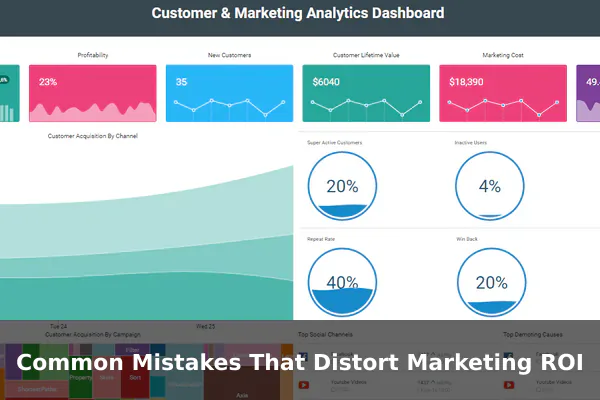
Most ROI problems are not caused by math errors. They are caused by weak assumptions, incomplete tracking, or inconsistent definitions. These mistakes can make bad campaigns look good and good campaigns look bad.
Using the wrong return number
The most common mistake is treating total revenue as if it were pure gain. Another version of the same problem is counting all company revenue during a campaign period as marketing-driven revenue, even when much of it would have happened anyway. ROI should reflect incremental or attributable return, not unrelated sales activity.
If a brand receives repeat purchases from existing customers, direct traffic from loyal audiences, and organic demand unrelated to a new campaign, it should not automatically assign all of that value to the latest marketing effort.
Ignoring attribution and time lag
Customers often interact with several touchpoints before buying. They may see an ad, read a comparison article, subscribe to email, return through branded search, and finally convert after a sales call. If your system gives 100% credit to the last click, upper-funnel channels may look weak even when they played a major role in creating demand.
Timing also matters. Measuring ROI too early can understate performance, especially in B2B, considered-purchase ecommerce, or subscription businesses with delayed conversion. Measuring too late can overstate performance by giving credit to campaigns that only had a minor role in the final sale.
Leaving out real costs
When teams exclude software, creative work, agency fees, internal labor, or post-conversion support, ROI becomes inflated. This is one reason internal reports sometimes show excellent performance while finance teams remain unconvinced. Both groups may be looking at the same campaign but using different definitions of cost.
Comparing channels with different goals
Not every channel exists to generate immediate sales. A brand awareness campaign, a remarketing campaign, and an email retention campaign can all influence revenue differently and on different timelines. If you judge all three using the same short-term ROI window, you may cut valuable channels simply because they do not behave like direct response media.
Trusting weak tracking and incomplete data
Broken pixels, missing UTM parameters, duplicate conversions, offline sales gaps, poor CRM hygiene, and inconsistent naming conventions all lead to distorted ROI. The formula can be perfectly correct and still produce a bad answer if the data feeding it is unreliable.
Warning signs that your ROI reporting may be distorted include:
- Different platforms report very different conversion totals for the same campaign.
- Sales teams cannot match lead quality with the channel reports.
- Revenue spikes appear without a clear change in traffic or demand.
- Campaigns with low conversion quality still show strong top-line ROI.
- The reported ROI changes dramatically when one cost category is finally added.
Good ROI measurement depends on disciplined definitions, solid tracking, and a realistic view of how buyers actually convert.
How to Improve Marketing ROI
Improving marketing ROI does not always mean spending less. In many cases, it means spending more intelligently, reducing waste, and raising the quality of the path from first click to final conversion.
Improve targeting and offer fit
If the wrong audience sees the message, even efficient media buying can produce poor ROI. Stronger audience segmentation, tighter keyword intent, better creative-message match, and more relevant offers help ensure that traffic has a realistic chance of converting.
- Refine audience segments based on buyer intent and purchase readiness.
- Separate prospecting campaigns from retargeting campaigns.
- Match landing pages to the promise made in the ad or email.
- Adjust offers by funnel stage instead of using one message for everyone.
Raise conversion efficiency before raising budget
Many teams try to improve ROI by chasing cheaper traffic, but the faster win is often improving the conversion path. If your landing page is slow, the form is too long, the call to action is unclear, or the sales follow-up is delayed, more traffic will only magnify inefficiency.
Practical improvements can include better page speed, clearer value propositions, stronger social proof, simpler checkout or demo requests, and better lead nurturing. Even a small increase in conversion rate can materially improve ROI because it lifts the return side without requiring a proportionate increase in cost.
Reallocate based on marginal performance
Average ROI can hide the fact that the next dollar spent in a channel performs differently from the previous one. A channel may look excellent at low spend and mediocre at higher spend. That is why smart budget allocation focuses on marginal ROI, not just average historical ROI.
Instead of asking which channel had the best past percentage, ask where the next unit of budget is most likely to create profitable incremental return. That approach leads to better scaling decisions.
Build a repeatable reporting cadence
Marketing ROI improves when measurement becomes a routine operating process rather than an occasional reporting exercise.
- Set one consistent formula and document it.
- Choose a clear attribution window for each channel type.
- Review both campaign-level and channel-level performance regularly.
- Separate fast-feedback campaigns from longer-horizon programs.
- Pause, fix, or scale campaigns based on pre-agreed thresholds.
Consistency is powerful. A perfect model is rare, but a stable model used thoughtfully is far more useful than a constantly changing one.
When Marketing ROI Should Not Be Judged in Isolation
Marketing ROI is valuable, but it is not a complete strategy by itself. Some marketing efforts create value that shows up indirectly, slowly, or in combination with other channels.
Brand building rarely pays back on the first click
Brand campaigns often influence future demand rather than immediate transactions. They can improve search demand, direct traffic, click-through rates, conversion rates, and trust across other channels. If you judge them only by short-term last-click ROI, you may underestimate their role in long-term growth.
That does not mean brand marketing should avoid accountability. It means the measurement model should reflect the actual purpose of the investment.
Long sales cycles need supporting metrics
In businesses with long or complex buying journeys, immediate ROI may be too narrow. A campaign that produces qualified pipeline today may not produce closed revenue for several months. In those cases, marketers should pair ROI with intermediate indicators that show whether the campaign is moving the right prospects through the funnel.
- Marketing qualified leads and sales qualified leads
- Opportunity creation rate
- Pipeline value influenced by channel
- Sales cycle length
- Payback period
- Customer lifetime value relative to acquisition cost
Use a scorecard instead of one isolated number
The best decision-making framework combines ROI with a small set of supporting metrics. That scorecard may include conversion rate, customer quality, retention, repeat purchase rate, assisted conversions, and payback period. ROI remains central, but it is interpreted in context rather than treated as the only signal that matters.
This is especially important when one channel captures demand and another creates it. Search ads, email, organic content, and social campaigns often work together. A narrow ROI view can reward the channel that closes the sale while undervaluing the channels that prepared the buyer to convert.
Key Takeaways for Smarter ROI Decisions
Marketing ROI is one of the most useful metrics in marketing because it connects spend to business results. At its best, it helps teams defend budgets, cut waste, compare channels, and invest in the tactics that truly create value. At its worst, it creates false confidence because the formula was fed incomplete costs, weak attribution, or the wrong return number.
A simple framework to apply every month
- Define return clearly. Decide whether you are using revenue, gross profit, contribution margin, or another return basis, and label it clearly.
- Capture full marketing cost. Include not just media spend, but also production, tools, labor, and support costs that materially affect performance.
- Match the time window to the buying journey. Short windows work for some campaigns, but not for every business model.
- Compare like with like. Evaluate channels with similar goals and similar attribution logic.
- Use ROI to improve decisions, not just reports. Reallocate budget, refine targeting, and fix conversion bottlenecks based on what the numbers reveal.
Conclusion
If you remember one idea from this article, it should be this: marketing ROI is only as trustworthy as the assumptions behind it. The formula itself is simple. The hard part is choosing realistic inputs, assigning value accurately, and measuring campaigns in a way that reflects how customers actually buy.
Businesses that do this well gain more than a clean report. They build a sharper marketing system. They know which channels deserve more investment, which campaigns need repair, and which results are real rather than cosmetic. That is what makes marketing ROI more than a metric. Used correctly, it becomes a practical tool for better strategy, better budgeting, and better growth decisions.
