

Product marketing sits at one of the most strategic intersections in any business: between the product team that builds solutions, the sales team that closes deals, and the customers who decide whether those solutions are worth buying. Yet for many organizations — especially growing ones — product marketing remains misunderstood, understaffed, or confused with neighboring roles. Understanding what product marketing is, who owns it, and how it actually drives revenue can change the way a company launches, positions, and grows.
Unlike general marketing, which focuses on building broad awareness, or product management, which focuses on what gets built, product marketing is specifically responsible for bringing a product to the right market — with the right message, at the right time, through the right channels. It is the function that connects deep customer knowledge to clear commercial outcomes.
This guide breaks down the full picture: the definition, the role of a product marketer, the key differences from adjacent functions, what a product marketing strategy looks like, how it works across the product lifecycle, and what success looks like in practice — with real-world examples throughout.
What Product Marketing Actually Means
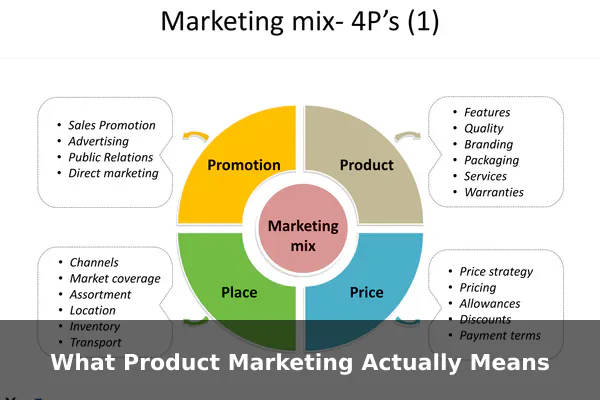
Product marketing is the process of understanding a product’s target audience, developing positioning and messaging that resonates with that audience, and executing the strategy that drives awareness, adoption, and retention. It answers three fundamental questions: Who is this product for? Why should they choose it? How do we get that message in front of them effectively?
The core goals of product marketing include:
- Market understanding: Researching who buys, who uses, and who influences purchasing decisions
- Positioning: Defining how the product fits in the market relative to competitors
- Messaging: Crafting language that communicates value clearly and persuasively
- Go-to-market execution: Planning and executing how the product reaches its audience
- Enablement: Equipping sales and customer success teams with the tools to close and retain
Product marketing solves a specific business problem: the gap between having a product and having a market that actually wants it. Even excellent products fail without effective product marketing. Conversely, strong product marketing can create momentum for a product that is still maturing.
What a Product Marketer Does
A product marketer wears many hats and often serves as the connective tissue across multiple departments. While the specific responsibilities vary by company size and stage, the core day-to-day work typically includes the following areas.
Audience Research and Customer Insights
Product marketers spend significant time understanding who their ideal customer is — not just demographics, but psychographics, jobs-to-be-done, pain points, and buying motivations. This involves customer interviews, surveys, win/loss analysis, and synthesizing feedback from sales and support teams. The output feeds into buyer personas and influences almost every other part of the role.
Positioning and Messaging
Based on customer research and competitive analysis, product marketers develop a positioning framework — a structured document that defines how the product is uniquely valuable to a specific audience. From that framework, they craft messaging: the headlines, taglines, key benefits, and supporting proof points that appear across websites, ads, sales decks, and emails.
Launch Planning and Execution
When a new product or feature is ready to ship, product marketing owns the go-to-market plan. This includes deciding the launch scope, coordinating across teams — content, design, sales, and PR — developing launch assets, and tracking performance post-launch. Launches range from quiet feature releases to major campaigns with coordinated email, paid, and social support.
Sales Enablement
Product marketers equip sales teams with the knowledge and materials they need to win deals. This includes competitive battlecards, one-pagers, pitch decks, demo guides, objection-handling scripts, and product training. Strong sales enablement shortens sales cycles and increases win rates by ensuring reps are armed with current, accurate messaging.
Retention and Adoption Support
Product marketing does not stop at acquisition. After a customer signs on, product marketers help drive feature adoption through in-app messaging, onboarding content, customer success playbooks, and lifecycle campaigns. This connects product marketing directly to retention metrics, not just acquisition numbers.
Product Marketing vs. Product Management vs. Brand Marketing
These three functions are often confused, especially in smaller organizations where one person may wear multiple hats. Understanding the distinctions helps companies hire correctly, set expectations, and avoid coverage gaps.
Product Marketing vs. Product Management
Product management is responsible for defining what gets built — the roadmap, the features, the user experience, and the technical requirements. Product managers work closely with engineering and design to build something that solves a real problem.
Product marketing is responsible for how that product reaches the market and how customers perceive it. Product marketers work closely with sales, marketing, and customer success to ensure the product is positioned, messaged, and launched effectively.
In short: product management decides what to build; product marketing decides how to bring it to market. They are deeply interdependent — the best outcomes happen when both functions collaborate closely throughout the product lifecycle.
Product Marketing vs. Brand Marketing
Brand marketing focuses on long-term perception, identity, and emotional association with a company. It shapes how audiences feel about the business as a whole — its values, personality, and reputation. Product marketing, by contrast, focuses on specific products and their commercial outcomes. It is more tactical, measurable, and tied to the product roadmap and sales cycle. While brand marketing asks what people think of the company, product marketing asks what people understand about a specific product and why they should buy it.
The Core Elements of a Product Marketing Strategy
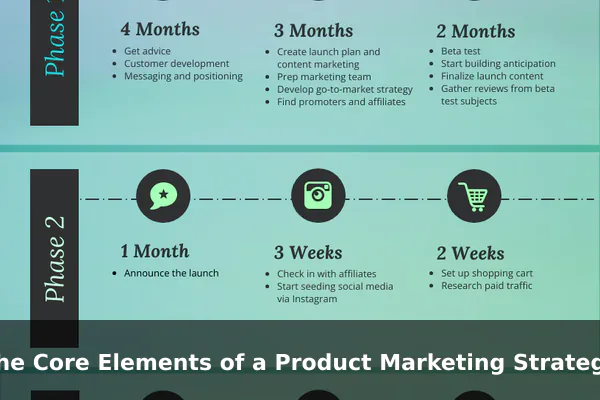
A product marketing strategy is not a single document — it is a set of decisions and outputs that guide how a product goes to market. The main elements include:
Target Audience Definition
Before any messaging or launch plan can be built, product marketers must define who they are targeting. This goes beyond a job title or industry segment. It includes the problems the audience faces, the language they use to describe those problems, and what motivates them to seek a solution. Strong audience definition makes every other element of the strategy more precise and impactful.
Market and Competitive Insight
Understanding the competitive landscape is essential. Product marketers analyze alternatives — both direct competitors and substitutes — to identify differentiation opportunities. This research shapes positioning and ensures messaging speaks to why this product beats the status quo, not just other named competitors.
Positioning Framework
A positioning framework typically includes:
- Who the product is for — the target segment
- What problem it solves — the core need
- What the product does — the solution
- Why it is better than alternatives — the differentiator
- What proof supports those claims — evidence and validation
This is an internal document used to align teams, not customer-facing copy — though it directly informs all customer-facing copy across every channel.
Value Proposition and Messaging Hierarchy
The value proposition is the clearest statement of why a specific customer should choose this product. From there, the messaging hierarchy provides supporting proof points organized by audience, use case, and channel. This hierarchy ensures consistency whether a customer reads the homepage, sees an ad, or speaks with a sales representative.
Go-to-Market Plan
The go-to-market (GTM) plan covers channels, timeline, launch milestones, and team responsibilities. It answers: Where will customers first hear about this? What is the launch sequence? What does success look like in the first 30 and 90 days? GTM plans range from a single landing page and email campaign to coordinated multi-channel launches with PR, events, and paid media.
Pricing Input
Product marketers often contribute to pricing decisions by synthesizing customer willingness-to-pay research, competitive pricing benchmarks, and perceived value signals. While pricing is often a shared decision across finance, product, and leadership, product marketing provides the customer perspective that anchors it to market reality.
How Product Marketing Works Across the Product Lifecycle
Product marketing is not a one-time event at launch — it evolves across the entire lifecycle of a product, adapting its focus as the product moves from development to maturity.
Pre-Launch: Research and Positioning
In the months before a product launches, product marketers conduct audience research, validate positioning hypotheses, develop messaging, create launch assets, and begin training internal teams. This is the highest-leverage phase because decisions made here cascade through everything that follows. Skipping it is one of the most common and costly mistakes growing companies make.
Launch: Execution and Activation
At launch, product marketing coordinates the release across channels. Content goes live, emails deploy, sales teams pitch the new product, PR stories run, and social campaigns begin. The product marketer tracks early signals — sign-ups, demos booked, media coverage, and social engagement — and adjusts quickly if something underperforms.
Post-Launch: Adoption and Growth
After launch, the focus shifts to adoption. Are new customers actually using the product? Are key features being discovered? Product marketers run campaigns to increase feature adoption, support onboarding improvements, gather new customer feedback, and feed insights back to the product team for the next iteration. This phase connects product marketing directly to retention metrics, not just acquisition.
Maturity and Repositioning
As a product matures, markets shift and competitors respond. Product marketing may revisit positioning, find new segments, retire old messaging, or support a repositioning effort that extends the product’s commercial life. This is also when product marketing often works on upsell and cross-sell campaigns that expand revenue from the existing customer base.
Examples of Product Marketing in Action
Seeing product marketing in practice makes the function more concrete. Here are three scenarios that illustrate how it works across different business types and situations.
SaaS Feature Launch
A project management software company launches an AI-powered task prioritization feature. The product marketer interviews existing customers and discovers that mid-level managers — not executives — feel the most pain around task prioritization. The team repositions the feature specifically for managers, builds messaging around stopping the guessing game of what to work on next, trains the sales team on common objections, and sequences a launch with a blog post, two email campaigns to current users, and a short LinkedIn video. Feature adoption among active users reaches 34% within the first month.
Ecommerce Product Repositioning
A skincare brand has a moisturizer that sells steadily but never breaks out. A product marketer reviews customer reviews, social mentions, and return data and finds that buyers repeatedly describe using it under makeup for a smooth base — a use case the brand never marketed. The product marketer repositions the moisturizer as a makeup-prep solution, updates the product description, creates a short how-to video, and runs a retargeting campaign to past purchasers. Sales increase 22% over the following quarter without any change to the product itself.
Feature Adoption Campaign
A B2B analytics platform launches a new reporting dashboard, but three months later adoption is low — only 18% of users have opened it. The product marketer segments the user base, identifies a cluster of power users who would benefit most, and runs a targeted in-app message campaign with a short tutorial video. Adoption in that segment lifts to 51% within six weeks, reducing churn risk and increasing the account expansion rate for that cohort.
How to Measure Product Marketing Success
Product marketing touches so many parts of the business that measuring it can feel difficult. The key is to tie metrics to the specific goals product marketing is accountable for at each stage.
Pre-Launch and Positioning Metrics
- Message resonance score: A survey-based measure of how clearly messaging lands with target audiences before launch
- Sales team confidence rating: Internal surveys on how prepared reps feel to pitch a new product or feature
- Asset completion rate: Percentage of launch assets delivered on schedule
Launch and Acquisition Metrics
- Launch-period sign-ups or trials: Volume of new interest generated in the launch window
- Pipeline influenced: Revenue in the sales pipeline where product marketing content or campaigns played a traceable role
- Win rate by segment: How often deals close against specific competitors in targeted segments
Post-Launch and Retention Metrics
- Feature adoption rate: Percentage of users who activate and meaningfully use a new feature
- Time-to-value: How quickly new customers reach their first meaningful outcome with the product
- Net revenue retention: Whether existing customers expand their spend over time
- Churn rate by cohort: Whether customers acquired through specific campaigns retain at higher rates than average
Common Product Marketing Mistakes to Avoid
Even experienced teams make recurring mistakes in product marketing. Recognizing them early prevents costly misfires at launch and beyond.
Positioning Without Customer Evidence
Many teams develop positioning based on internal assumptions — what the product team thinks is best — rather than what customers actually value. This leads to messaging that sounds compelling internally but fails to resonate externally. The fix is to anchor every positioning decision in direct customer research conducted before the messaging is written.
Vague or Generic Messaging
Phrases like powerful, easy-to-use, or all-in-one solution appear on thousands of product pages. They say nothing specific and help no one decide. Strong product marketing messaging is concrete and specific, and it speaks to a clearly defined audience — not everyone who might theoretically buy.
Poor Alignment With Sales
Product marketing that does not involve sales teams in the development process produces materials that reps do not use. Sales enablement is most effective when reps provide input on common objections, competitor mentions, and buyer language — and when product marketers deliver live training, not just documents sent over email.
Launching Without a Post-Launch Plan
A common failure mode is putting all effort into launch day and doing nothing the week after. Launches that do not drive adoption quickly lose momentum. Product marketing should plan post-launch campaigns, onboarding sequences, and follow-up touchpoints before the launch date — not scramble to create them after the fact.
Ignoring Competitive Dynamics
Markets do not stand still. If product marketing ignores what competitors are doing — new pricing, new messaging, new features — positioning can become stale and messaging can sound outdated within months. Regular competitive monitoring and quarterly positioning reviews keep the strategy current and the team proactive rather than reactive.
Conclusion
Product marketing is not a support function — it is a strategic driver of how products grow, how revenue is generated, and how customers perceive value. When done well, it creates alignment across product, sales, and marketing; gives customers a clear reason to choose and stay with a product; and accelerates growth in ways that no single channel or campaign could achieve alone.
Whether you are building your first product marketing function, improving an existing one, or simply trying to understand what the role involves, the core principles are consistent: start with deep customer knowledge, build clear positioning, craft specific messaging, execute a coordinated go-to-market plan, and measure what matters at every stage. That is product marketing — and when it works well, the entire business feels the difference.
