
Brand positioning is one of the most powerful concepts in marketing, yet it is frequently misunderstood or treated as an afterthought. At its core, brand positioning defines the mental space your brand occupies in a customer’s mind relative to your competitors. It is not just a logo, tagline, or color palette — it is the reason a customer chooses you over everyone else.
In competitive markets, brands that lack clear positioning often struggle with inconsistent messaging, unclear value propositions, and low customer loyalty. Whether you are building a new brand or refining an existing one, understanding brand positioning is essential for long-term marketing success.
What Brand Positioning Actually Means
Brand positioning is the strategic process of defining how your brand is perceived by your target audience in relation to competing brands. Marketing strategists Al Ries and Jack Trout, who popularized the concept in their landmark book Positioning: The Battle for Your Mind, described it as claiming a unique space in the consumer’s memory.
It is important to distinguish brand positioning from related concepts:
- Brand identity refers to the visual and verbal elements — logo, typography, and tone of voice — that represent your brand.
- Branding is the broader practice of creating a memorable overall brand experience.
- Brand positioning is specifically about competitive perception — where you stand in the customer’s mind relative to alternatives.
A strong brand position answers one key question: Why should a customer choose you over anyone else?
Core Elements of a Brand Positioning Statement
A brand positioning statement is an internal strategic document that articulates your position clearly and concisely. It typically follows this formula:
For [target audience], [brand name] is the [category/market] that [key benefit] because [reason to believe].
The four core components are:
- Target Audience — Who your ideal customer is, defined by demographics, psychographics, or behavior.
- Market Category — The competitive space you occupy, such as premium skincare, budget airline, or project management software.
- Key Benefit — The single most compelling advantage that sets you apart from alternatives.
- Reason to Believe — The proof point or evidence that supports your claimed benefit.
Example: For small business owners, FreshBooks is the accounting software that makes financial management effortless because it was designed specifically for non-accountants.
Types of Brand Positioning Strategies
Different brands use different positioning approaches depending on their strengths and competitive context. Here are the five most common strategies:
Price-Based Positioning
Brands positioned on price compete by being the most affordable option in their category. Walmart and Ryanair use this approach effectively. While it attracts cost-conscious customers, it carries the risk of triggering a price war with little room for genuine differentiation.
Quality-Based Positioning
These brands compete on premium craftsmanship, materials, or performance. Luxury brands like Rolex and Louis Vuitton command higher prices and build aspirational appeal. The key is delivering on the premium promise at every customer touchpoint.
Use-Case or Benefit Positioning
This strategy focuses on a specific problem the brand solves better than anyone else. Slack positioned itself as the tool that replaces email for teams. Benefit positioning works best when a clear, underserved customer need exists in the market.
Competitor-Based Positioning
This approach explicitly defines your brand against a specific competitor. Avis’s classic campaign We Try Harder directly positioned the brand against market leader Hertz. It requires careful execution to avoid appearing reactive rather than confident.
Values-Based Positioning
Brands like Patagonia position themselves around shared values — in their case, environmental sustainability. This builds deep loyalty among customers who align with those values and creates emotional differentiation that price cuts cannot easily replicate.
How to Build a Brand Positioning Strategy
Building an effective brand position requires a structured, research-driven process. Here is a step-by-step approach:
Step 1: Research Your Target Audience
Start by understanding your customers deeply. What problems do they face? What do they value most? Use surveys, customer interviews, and behavioral data to build a clear profile. The more precisely you define your audience, the sharper your positioning can be.
Step 2: Map the Competitive Landscape
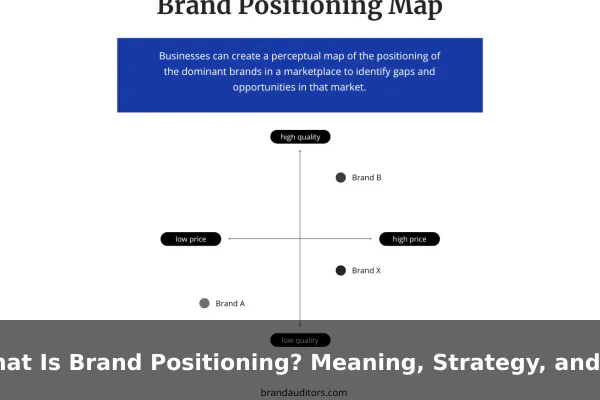
Identify your main competitors and analyze how each is positioned. A positioning map — a simple two-axis grid such as price vs. quality or traditional vs. innovative — helps you visualize where competitors cluster and where market gaps exist.
Step 3: Identify Your Unique Differentiator
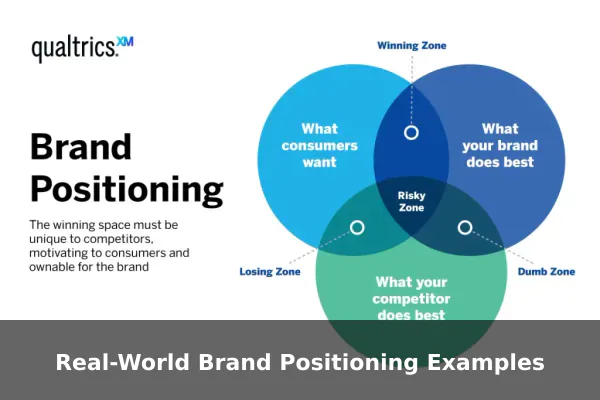
Find the intersection of three things: what your customers need most, what you do exceptionally well, and what competitors do not adequately offer. That intersection is your positioning opportunity.
Step 4: Write Your Positioning Statement
Using the four-component formula, draft a clear internal positioning statement. Keep it specific and honest — overpromising leads to brand credibility problems down the line.
Step 5: Apply It Consistently
Positioning must show up across every customer touchpoint: website copy, advertising, customer service tone, product decisions, and social media content. Inconsistency is one of the fastest ways to erode trust and blur your market position.
Real-World Brand Positioning Examples
Looking at how successful brands have applied positioning strategy reveals practical lessons worth studying:
Apple — Premium Innovation and Simplicity
Apple positions itself at the intersection of technology and human-centered design. Its brand does not just sell computers or phones — it sells the experience of creative empowerment. Every product launch, retail store, and ad campaign reinforces this consistent position.
Nike — Athletic Aspiration for Everyone
Nike’s Just Do It positioning is values-based, celebrating athletic determination rather than specific product features. This positioning connects equally with elite athletes and everyday gym-goers, creating a broad but emotionally powerful brand position.
Volvo — Owning Safety
For decades, Volvo has owned the safety positioning in the automotive market. Even as other manufacturers improved their safety ratings, Volvo’s relentless messaging made safety synonymous with its brand name — a textbook example of owning a single, defensible attribute over the long term.
Dove — Real Beauty Over Perfection
Dove disrupted the beauty industry by positioning against the idealized standards promoted by most competitors. Its Real Beauty campaign built a values-based position around authenticity and inclusion, differentiating it sharply from conventional cosmetic brands.
Common Brand Positioning Mistakes to Avoid
Even well-resourced brands make positioning errors that cost them market share and customer trust. The most common pitfalls include:
- Positioning too broadly. Trying to appeal to everyone results in being memorable to no one. Effective positioning requires deliberate trade-offs.
- Copying competitors. Positioning that mirrors what a competitor already owns will always come across as second-best. Genuine differentiation is the goal.
- Inconsistency across channels. A brand that feels premium online but delivers mediocre customer service sends conflicting signals that undermine the positioning.
- Failing to evolve. Markets shift, new competitors enter, and customer expectations change. Positioning should be reviewed periodically and refined when needed.
- Confusing positioning with taglines. A tagline is the public expression of your position — not the position itself. Strategy always comes first; creative execution follows.
Avoiding these mistakes is as important as getting the initial positioning right. Brands that stay disciplined about their position over time build strong, durable mental associations that are very difficult for competitors to displace.
Conclusion
Brand positioning is the strategic foundation that makes every other marketing decision more coherent and effective. When you know exactly where you stand in the customer’s mind — and why — your messaging becomes sharper, your targeting becomes more precise, and your brand becomes harder to ignore.
The brands that consistently win in competitive markets are not always the biggest or the first to market. They are the ones that claim a specific, believable, and consistently delivered position. Whether you are building a brand from scratch or revisiting an existing strategy, investing in clear brand positioning is one of the highest-leverage decisions you can make as a marketer.
