
Referral marketing is one of the oldest forms of promoting a business — yet it has evolved into a powerful, measurable strategy that companies of all sizes now use to grow. At its core, it turns satisfied customers into brand advocates who actively bring in new buyers.
Unlike traditional advertising, referral marketing works because it leverages trust. When a friend, colleague, or family member recommends a product or service, that recommendation carries far more weight than a paid ad. That trust is what makes referral programs so effective, and why brands from early-stage startups to global enterprises have made them a central part of their customer acquisition strategy.
Referral Marketing Explained
Referral marketing is a strategy where a business encourages existing customers to recommend its products or services to people they know. In return, the referring customer — and sometimes the new customer — receives a reward such as a discount, store credit, free product, or cash incentive.
Three main parties are involved in every referral program:
- The brand — which designs, funds, and tracks the referral program
- The referrer — an existing customer who shares a referral link or code
- The referred customer — a new prospect who discovers the brand through that recommendation
What separates referral marketing from general word-of-mouth is structure. Word-of-mouth happens organically, without incentive or tracking. Referral marketing is systematic: it gives customers a specific tool to share, a clear reason to do so, and a measurable outcome for the business.
How Referral Marketing Works Step by Step
Understanding the mechanics helps clarify why this model is so effective. Here is how a typical referral cycle unfolds:
- A customer has a positive experience. The foundation of any referral program is product or service satisfaction. An unhappy customer will not refer anyone.
- The brand invites the customer to share. Through an email, in-app prompt, or post-purchase message, the brand presents the referral offer and provides a unique link or code.
- The customer shares with their network. The referrer sends the link via message, email, or social media to friends and contacts.
- A new customer clicks and converts. The referred prospect follows the link, signs up, or makes a purchase.
- Both parties are rewarded. Depending on the program structure, the referrer, the new customer, or both receive their incentives automatically.
- The cycle continues. The newly acquired customer may also become a referrer, creating a compounding growth loop.
Why Referral Marketing Matters for Business Growth
Referral marketing is not just a feel-good tactic. It has measurable advantages over most paid acquisition channels.
Higher Trust and Conversion Rates
Recommendations from real people are far more credible than ads. Referred leads convert at higher rates and with less friction than cold traffic because they arrive with a baseline of trust already established.
Lower Customer Acquisition Cost
Because the referrer does the outreach, the brand spends less per acquired customer compared to running paid campaigns. The main cost is the reward itself, which is only triggered on a successful conversion — making the spend highly efficient.
Better Long-Term Retention
Referred customers tend to stay longer. They arrived through a trusted recommendation, which sets a positive expectation and builds loyalty from the very first interaction.
Scalable and Self-Sustaining Growth
Once a referral program is live and promoted consistently, it continues working without constant manual effort, generating new leads from an expanding network of satisfied advocates.
Common Referral Marketing Models
Not all referral programs are structured the same way. The most common formats include:
- One-sided reward — Only the referrer receives a benefit. Simple to run but less compelling for new customers.
- Two-sided reward — Both the referrer and the new customer receive an incentive. Typically delivers higher conversion rates because there is a clear benefit on both sides.
- Discount-based referral — Both parties receive a percentage off their next purchase. Popular in e-commerce.
- Account credit — The referrer earns credits applied to future use of a product or service. Common in SaaS and subscription businesses.
- Loyalty-driven referral — Referrals are integrated into a points or loyalty system where customers accumulate rewards over time.
The right model depends on your business type, margin structure, and what motivates your existing customer base most strongly.
What Makes a Referral Program Effective
A referral program that looks good on paper can underperform in practice if key elements are missing. Effective programs share these characteristics:
Clear and Attractive Incentive
The reward must feel worth the effort of sharing. If the incentive is too small or too complicated to redeem, customers will simply ignore the offer.
Easy Sharing Mechanism
Friction kills referrals. Customers should be able to copy a link, tap a share button, or send a code in seconds. The fewer steps, the higher the participation rate.
Simple Terms and Right Timing
Complicated conditions — such as minimum order thresholds, short expiry windows, or multi-step requirements — reduce participation significantly. Ask for referrals when satisfaction is highest: right after a successful purchase, a positive review, or a meaningful customer milestone.
Referral Marketing vs Affiliate Marketing
These two channels are often confused, but they serve different audiences and operate on different relationships.
- Referral marketing targets existing customers. The motivation is personal satisfaction and peer-to-peer trust. Rewards are typically modest and experiential.
- Affiliate marketing targets content creators, publishers, and marketers outside the customer base. The motivation is primarily financial commission. Affiliates promote to audiences they have built, not personal networks.
Referral programs build customer advocacy. Affiliate programs build a performance-based distribution network. Both have value, but they serve different growth goals and require different management approaches.
Common Mistakes to Avoid
Even well-intentioned programs fail due to avoidable errors:
- Asking too early — Prompting a referral before the customer has experienced real value creates pressure and low results.
- Weak incentives — A reward that does not match the effort of sharing will be ignored.
- Poor tracking — Without reliable attribution, the business cannot confirm which referrals converted, making accurate reward fulfillment impossible.
- Over-complicating the rules — Long terms and conditions erode trust and discourage participation.
- Not promoting the program — A referral program buried in a footer will generate almost no results. It needs active promotion across email, post-purchase flows, and the product interface.
How to Start a Referral Program
Starting a referral program does not require a large budget or complex technology. A practical launch plan looks like this:
- Define your goal. Focus on new customer acquisition, repeat purchases, or brand awareness — not all three at once.
- Choose your reward structure. Decide between one-sided or two-sided rewards, and what type of incentive fits your product and margins.
- Set simple rules. When is the reward triggered? How does the referrer access it? Keep the answer to one clear sentence.
- Select a platform or tool. Many referral software solutions integrate directly with e-commerce platforms, CRMs, and email systems.
- Create a landing page. Give referred visitors a welcoming destination that explains the offer and makes conversion straightforward.
- Launch and promote. Send an email announcement, add a prompt to your post-purchase sequence, and include it in your onboarding flow.
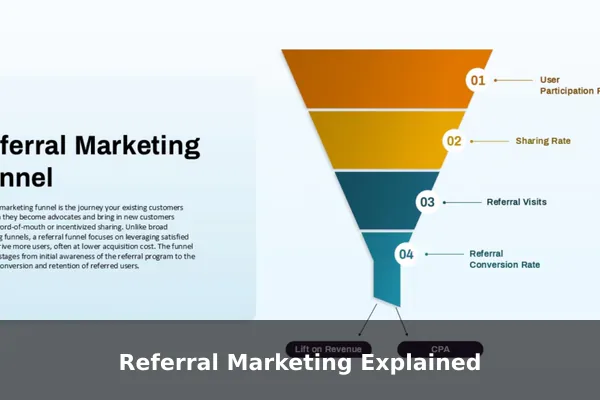
- Monitor and optimize. Track referral rate, click-through rate, and conversion rate. Adjust the incentive or messaging based on what you observe.
Conclusion
Referral marketing is one of the most cost-effective and trust-driven growth strategies available to modern businesses. By giving satisfied customers a structured way to share their experience, brands can reduce acquisition costs, improve conversion rates, and build a more loyal customer base over time. Whether you run a small online store or a growing subscription service, a well-designed referral program has the potential to become one of your most reliable and self-sustaining acquisition channels. Start simple, track the results, and optimize from there.
