
In the past decade, the internet has fundamentally transformed how businesses reach their customers. Whether you are browsing Instagram, searching on Google, opening a promotional email, or watching a YouTube tutorial, you are experiencing digital marketing firsthand. Yet despite how omnipresent it has become, many business owners and aspiring marketers still struggle to define it clearly — let alone use it effectively.
Digital marketing, in the simplest terms, is any form of marketing that happens online or through digital devices. It encompasses everything from a Google search ad to a viral TikTok video, from a nurture email sequence to a blog post ranking on page one. Unlike traditional marketing — think billboards, TV commercials, and print ads — digital marketing gives brands the power to reach specific audiences, track every interaction, and adjust strategies in real time based on hard data.
This guide breaks down what digital marketing really means, the channels it includes, how it compares to traditional marketing, and how real businesses use it to grow. Whether you are a small business owner just getting started or a marketing professional looking to sharpen your knowledge, understanding digital marketing is no longer optional — it is essential.
What Is Digital Marketing?
Digital marketing is the promotion of products, services, or brands through internet-connected platforms and digital devices. It is an umbrella term that covers a wide range of online marketing activities — not a single tactic, tool, or platform. At its core, digital marketing connects businesses with their target audiences where those audiences already spend their time: online.
According to global internet usage data, the average person spends more than six hours per day on internet-connected devices. Digital marketing allows brands to show up in those moments — at the right time, on the right platform, with the right message. Unlike a single-channel approach, effective digital marketing often involves multiple touchpoints across a customer’s journey. A customer might first discover a brand through a Google search, then see a retargeted ad on Facebook, read a blog post, and finally convert after receiving a promotional email. Each of these interactions is a component of digital marketing working together as a cohesive system.
Key Characteristics of Digital Marketing
- Data-driven: Every click, impression, and conversion can be tracked and measured with precision.
- Targeted: Campaigns can be directed at specific demographics, interests, behaviors, or geographic locations.
- Interactive: Unlike TV ads, digital content invites comments, shares, clicks, and direct responses from audiences.
- Scalable: A campaign can start small and scale rapidly as budgets grow and results are validated.
- Cost-effective: Even businesses with modest budgets can compete with larger brands through smart, targeted digital strategies.
- Measurable: ROI can be calculated with far greater accuracy than most traditional marketing methods allow.
How Digital Marketing Works
Understanding how digital marketing works means understanding the relationship between audiences, platforms, data, and content. At the highest level, digital marketing operates through a repeating cycle of planning, execution, measurement, and optimization.
- Define the audience: Who are your ideal customers? What are their demographics, interests, pain points, and online behaviors?
- Choose the right channel: Different channels reach different audiences. A B2B software company might invest in LinkedIn and SEO, while a fashion brand might prioritize Instagram and influencer partnerships.
- Create and distribute content: This could be a blog post, a paid search ad, a social media reel, or a promotional email sequence.
- Collect and analyze data: Digital platforms provide detailed analytics — how many people saw the content, clicked on it, spent time with it, and ultimately converted into customers or leads.
- Optimize: Based on performance data, marketers refine their messaging, targeting, creatives, and budgets to continuously improve results over time.
This iterative loop — publish, measure, learn, optimize — is what makes digital marketing fundamentally different from traditional marketing. You do not wait weeks for survey results or sales reports; you see performance data in real time and respond accordingly. This agility is one of the most powerful advantages digital marketing offers modern businesses.
The Role of the Customer Journey
Digital marketing aligns closely with the modern customer journey. Most frameworks describe this journey in stages: Awareness, Consideration, and Decision. Digital channels map neatly onto each stage, allowing brands to guide prospects from first exposure to final purchase.
- Awareness: SEO, social media, display ads, and content marketing introduce the brand to new audiences who may not have been actively searching for a solution.
- Consideration: Email marketing, retargeting ads, comparison content, and case studies help prospects evaluate their options and build trust in your brand.
- Decision: Landing pages, testimonials, special offers, and streamlined product pages convert interested prospects into paying customers.
Understanding where your audience is in this journey allows you to deliver the right message at exactly the right moment, dramatically increasing the effectiveness of your campaigns.
Main Digital Marketing Channels
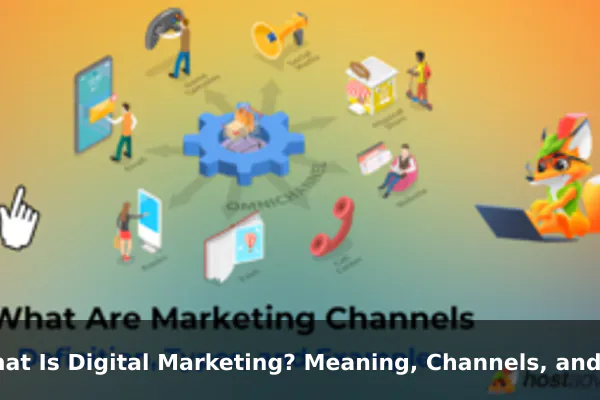
One of the most important things to understand about digital marketing is that it is not one thing — it is many things working together. Here is an overview of the primary digital marketing channels every marketer and business owner should understand.
1. Search Engine Optimization (SEO)
SEO is the practice of optimizing your website and content so that it ranks higher in organic, unpaid search engine results. When someone types a query into Google or Bing, SEO determines whether your page appears — and where. SEO involves keyword research, on-page optimization (titles, headings, content quality), technical improvements (site speed, mobile-friendliness), and off-page factors such as earning backlinks from authoritative sources.
SEO is a long-term strategy that builds sustainable, compounding traffic over time. A well-optimized blog post can continue driving visitors for years without ongoing ad spend, making it one of the most cost-efficient digital marketing channels available.
2. Pay-Per-Click Advertising (PPC)
PPC advertising allows businesses to place ads on search engines, websites, and social platforms and pay only when someone clicks. Google Ads is the most widely used PPC platform, enabling brands to appear at the top of search results for specific keywords almost immediately.
Unlike SEO, PPC delivers instant visibility. It is highly controllable — marketers set daily budgets, select target keywords, write ad copy, and define audience parameters. The primary trade-off is that traffic stops the moment spending stops, which is why PPC and SEO are often used together for a balanced strategy.
3. Social Media Marketing
Social media marketing involves creating and sharing content on platforms such as Facebook, Instagram, LinkedIn, TikTok, X (formerly Twitter), and Pinterest to build brand awareness, engage communities, and drive traffic or sales. Organic social media relies on consistently posting valuable content and building a loyal following over time. Paid social media — boosted posts and targeted ad campaigns — extends reach beyond your existing audience with precision targeting based on age, location, interests, and online behaviors.
4. Content Marketing
Content marketing is the creation and distribution of valuable, relevant content — blog posts, videos, infographics, podcasts, whitepapers, and more — to attract and engage a defined target audience without directly promoting a product. The philosophy is that by educating and informing your audience, you build trust and authority, which eventually leads to more business. Content marketing works best in conjunction with SEO, as high-quality content drives organic search traffic while building brand credibility.
5. Email Marketing
Email marketing involves sending targeted messages directly to subscribers’ inboxes to nurture relationships, share updates, and drive conversions. Despite being one of the oldest digital marketing channels, email consistently delivers some of the highest returns on investment — often cited at $36 to $42 earned for every $1 spent.
Effective email marketing goes beyond mass-blasting a list. It involves segmentation (grouping subscribers by interest or behavior), personalization, automation (sending triggered emails based on user actions), and ongoing A/B testing to continuously improve open rates and click-through rates.
6. Affiliate Marketing
Affiliate marketing is a performance-based channel where businesses pay external partners — known as affiliates — a commission for driving traffic or sales to their website. Affiliates may be bloggers, review sites, comparison platforms, or content creators who promote products using unique tracking links. Because businesses only pay for results, affiliate marketing carries relatively low financial risk and can scale reach significantly without large upfront investments.
7. Influencer Marketing
Influencer marketing leverages individuals with established online audiences — from mega-celebrities to niche micro-influencers — to promote a brand’s products or services. Because followers often trust an influencer’s recommendations more than traditional advertising, this channel can be highly effective for brand discovery and credibility building. The key to success lies in choosing influencers whose audience genuinely aligns with the brand’s target market, rather than simply selecting the account with the largest follower count.
8. Video Marketing
Video has become one of the most consumed content formats online. Platforms like YouTube, TikTok, and Instagram Reels have made video marketing accessible to businesses of all sizes. Video content can be used for product demonstrations, how-to tutorials, brand storytelling, customer testimonials, and behind-the-scenes content. Research consistently shows that video increases time on page, improves engagement rates, and boosts conversion rates — making it a critical component of any modern digital marketing strategy.
Digital Marketing vs. Traditional Marketing
Understanding how digital marketing differs from traditional marketing helps explain why so many businesses are shifting their budgets online. Both approaches aim to reach customers and drive business growth, but they operate in fundamentally different ways.
| Factor | Digital Marketing | Traditional Marketing |
|---|---|---|
| Targeting | Highly specific — age, location, interests, behavior | Broad, primarily demographic-based |
| Measurability | Real-time, granular analytics available | Difficult to measure precisely |
| Cost | Flexible — can start with small budgets | Often expensive — TV, print, billboards |
| Reach | Global, available 24 hours a day | Typically local or regional |
| Interaction | Two-way — comments, clicks, shares | One-way communication |
| Speed | Campaigns can launch within hours | Lead times often weeks or months |
| Adjustability | Campaigns can be refined in real time | Changes are costly and slow |
This does not mean traditional marketing is obsolete. Many brands use a blend of both — a television commercial builds broad brand awareness, while digital remarketing re-engages viewers who looked up the brand afterward. However, for businesses with limited budgets and a need for measurable ROI, digital marketing offers an unmatched advantage.
Why Businesses Are Shifting Budgets Online
- Consumers are online: More than 5 billion people use the internet globally, and most purchase decisions begin with an online search or social media browsing session.
- Lower cost per acquisition: Digital channels — especially SEO and email — typically cost less per customer acquired than television or print advertising.
- Better attribution: Digital tools allow marketers to trace a sale back to the specific ad, keyword, or email that triggered the purchase.
- Speed to market: A social media ad campaign can be live within hours; a new email nurture sequence can deploy the same day it is created.
- Continuous optimization: Unlike a print ad that cannot be changed once published, digital campaigns can be adjusted based on real-time performance data.
Real-World Examples of Digital Marketing
Theory is valuable, but seeing digital marketing in action makes the concepts concrete. Here are four real-world examples illustrating different channels and business sizes.
Nike — Social Media and Content Marketing
Nike is one of the most recognized brands in the world, and its digital marketing strategy is a masterclass in audience-first storytelling. Rather than simply promoting products, Nike’s social media content focuses on athletic achievement, personal motivation, and cultural relevance. Campaigns extended through Instagram, X, and YouTube generate massive organic engagement because the content resonates emotionally, not just commercially.
Nike also produces high-quality video content — mini-documentaries, athlete stories, and motivational short films — that performs across YouTube and social channels. By creating content people genuinely want to watch and share, Nike builds brand equity that far exceeds what traditional advertising alone could achieve.
HubSpot — Content Marketing and SEO
HubSpot’s growth story is one of the most cited case studies in the digital marketing world. The company built its brand largely through a content marketing strategy centered on an educational blog, free tools, and in-depth guides. By consistently publishing high-quality, search-optimized content about marketing, sales, and customer service topics, HubSpot attracted millions of organic visitors who eventually converted into paying software customers.
Today, HubSpot’s blog ranks on the first page of Google for thousands of competitive marketing keywords. This is a textbook example of how content marketing and SEO, used together over time, can become a company’s most powerful and cost-efficient customer acquisition engine.
Amazon — PPC and Personalized Email Marketing
Amazon uses pay-per-click advertising at massive scale — both on its own platform through Sponsored Products and on external display networks. Sellers on Amazon can pay to have their products appear at the top of search results, driving highly qualified traffic from buyers already in a purchasing mindset. This targeted intent-based advertising makes PPC exceptionally efficient at driving conversions.
Amazon is also renowned for its personalized email and product recommendation engine. The familiar prompt — customers who bought this item also bought — is powered by behavioral data and automation, and it drives a significant percentage of Amazon’s overall revenue. It is a prime example of email marketing and data-driven personalization working at sophisticated scale.
A Local Bakery — Email Marketing and Local SEO
Digital marketing is not exclusive to global corporations. Consider a local bakery that collects email addresses from in-store customers and online orders. By sending a weekly email featuring seasonal specials, new flavor announcements, and subscriber-only discounts, the bakery keeps customers engaged between visits and drives repeat foot traffic.
The bakery also maintains an optimized Google Business Profile with photos, current business hours, and regular posts about new items. This local SEO strategy ensures the bakery appears prominently when nearby customers search for terms like best bakery near me — driving valuable foot traffic without spending a single dollar on paid advertising.
Benefits of Digital Marketing for Businesses
Regardless of size, industry, or budget, the benefits of digital marketing are compelling for virtually any business that wants to grow its customer base and revenue in today’s connected world.
Measurable Return on Investment
Every digital marketing channel provides trackable data. You can see exactly how many people saw your ad, clicked it, visited your landing page, and completed a purchase. This level of accountability makes it possible to calculate ROI with real precision, justify marketing budgets to stakeholders, and allocate spending toward what actually works.
Precise Audience Targeting
Digital platforms allow you to define your audience with remarkable specificity. You can target campaigns by age, gender, location, device type, browsing history, past purchases, and declared interests. This precision dramatically reduces wasted ad spend and increases the personal relevance of your campaigns to the people who receive them.
Scalability on Any Budget
A digital marketing campaign can start with a modest daily budget and scale to thousands of dollars as results validate the investment. Small businesses can compete in the same digital spaces as large corporations by targeting more intelligently, not necessarily by spending more. This scalability makes digital marketing one of the most equitable marketing environments ever created.
Round-the-Clock Visibility
A well-optimized website, active social media profile, or live advertising campaign works around the clock — every hour of every day. Unlike a storefront that closes at night, your digital presence remains accessible to potential customers regardless of time zone or hour, expanding your reach far beyond your physical location or business hours.
Lower Barrier to Entry
Launching a blog, setting up a social media business profile, or running a Google Ads campaign requires significantly less capital than purchasing a television slot or a roadside billboard. This democratization of marketing gives startups, freelancers, and small business owners access to powerful promotional tools that previously only large enterprises could afford.
How to Get Started with Digital Marketing
Getting started with digital marketing does not require mastering every channel simultaneously. The most effective approach is to start focused, build momentum, and expand strategically over time. Here is a practical five-step process to launch your digital marketing efforts.
Step 1: Define Your Goals
Before choosing any channel or creating any content, get clear on what you want to achieve. Common digital marketing goals include building brand awareness, generating qualified leads, driving direct online sales, or improving customer retention. Clear, measurable goals determine which channels, metrics, and content formats make the most sense for your business.
Step 2: Know Your Audience
Build a detailed profile of your ideal customer. Consider their age, location, profession, interests, challenges, and online habits. Where do they spend time online? What questions are they searching for? What kind of content do they engage with? The more specific your audience understanding, the more effectively you can reach and resonate with them through digital channels.
Step 3: Choose One or Two Channels
Resist the temptation to be everywhere at once. Start with one or two channels that best match your audience profile and business goals:
- B2B businesses often find the most traction with LinkedIn content, email marketing, and SEO-driven thought leadership.
- E-commerce brands typically benefit from Google Shopping ads, Instagram, and automated email sequences.
- Local service businesses should prioritize Google Business Profile optimization, local SEO, and Facebook community engagement.
- Content-driven brands often start with a blog combined with email list building to capture and retain an audience over time.
Step 4: Create and Publish Valuable Content
Develop content that addresses your audience’s real needs and aligns with the channels you have chosen. For SEO, write blog posts that answer the questions your customers are already searching. For social media, create visuals, short videos, or stories that entertain, inform, or inspire. For email, craft sequences that add value and nurture new subscribers into loyal customers over time.
Step 5: Track, Measure, and Optimize
Set up analytics tools — Google Analytics for your website, native analytics within social platforms, and your email provider’s reporting dashboard — and review performance consistently. Look at what is working (strong traffic, high open rates, solid conversion numbers) and what is underperforming. Continuously test headlines, creatives, calls to action, and audience segments. Digital marketing rewards those who iterate rather than those who set-and-forget.
Conclusion
Digital marketing is no longer a niche skill or a future consideration — it is the foundation of modern business growth. Whether you are a solo entrepreneur launching your first product, a startup founder building an audience, or a marketing manager at a scaling company, understanding what digital marketing is, how its channels work, and how to apply them strategically is essential for reaching today’s digitally connected consumers.
The most encouraging reality about digital marketing is that it is both learnable and accessible. Start with clear goals, choose the right channels for your specific audience, create content that delivers genuine value, and let data drive your ongoing decisions. The brands that grow fastest in the digital age are not necessarily those with the largest budgets — they are the ones that listen carefully to their audiences, test relentlessly, show up consistently, and keep improving.
Now that you understand the meaning, main channels, and real-world examples of digital marketing, the path forward is straightforward: pick one channel, take one focused action, and begin building your digital presence today. Every successful digital marketing strategy started exactly where you are right now.
