
Conversion rate is one of the most cited numbers in marketing dashboards, yet teams frequently calculate it in different ways, compare it across unequal contexts, or chase the metric without understanding what it actually represents. A clear, shared definition turns conversion rate from a vanity figure into a reliable signal that guides budget, creative, and product decisions.
This guide explains what conversion rate means, shows the exact formula used by leading analytics platforms, walks through worked examples across e-commerce, lead generation, and email, and offers cautious guidance on benchmarks and improvement. The terminology is anchored to official documentation from Google Analytics, the American Marketing Association, HubSpot, and Adobe Analytics, so you can apply it consistently across teams and tools.
What Conversion Rate Actually Means
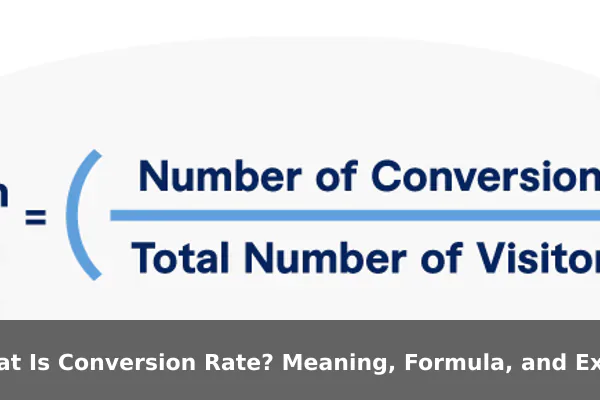
In simple terms, conversion rate is the percentage of people who complete a desired action out of the total who had the opportunity to complete it. The desired action — called a conversion — is defined by the business and can range from buying a product to filling out a contact form, subscribing to a newsletter, downloading a whitepaper, or even clicking a specific button.
Google Analytics documentation describes a conversion as a key event that is meaningful to the success of a website or app, and conversion rate as the share of sessions or users that triggered that event. The American Marketing Association similarly frames the metric as a measure of marketing effectiveness: how well a campaign, channel, or page persuades the audience to take the next step.
Conversion vs. Visit vs. Lead
It is important to distinguish three related ideas:
- Visit or session: a person arrives at your site or app.
- Lead: a visitor who shares contact information, indicating interest.
- Conversion: any predefined action you choose to count — purchase, signup, demo request, or another key event.
Every conversion is built on a visit, but not every visit becomes a conversion. The ratio between the two is what conversion rate measures.
The Conversion Rate Formula
The core formula is straightforward:
Conversion Rate = (Number of Conversions ÷ Total Interactions) × 100
The result is expressed as a percentage. The denominator — total interactions — is where most calculation differences appear. Depending on what you are measuring, it can be:
- Sessions: every visit, even repeat visits from the same user. Common for landing page and campaign analysis.
- Users: unique people who visited in the period. Common for account-based or lifecycle reporting.
- Ad clicks or impressions: used in paid-media reporting to evaluate creative performance.
- Emails delivered or opened: used in email marketing to evaluate audience engagement.
Common Miscalculations
Several mistakes can distort the number:
- Mixing denominators: comparing a session-based rate to a user-based rate gives misleading conclusions.
- Double-counting conversions: if one user converts twice in a session, decide whether to count one or two.
- Including bot or internal traffic: inflates the denominator and lowers the rate artificially.
- Ignoring the funnel stage: a top-of-funnel page should not be judged by checkout conversion expectations.
Worked Examples Across Channels
Three quick examples show how the same formula adapts to different contexts.
Example 1: E-commerce Checkout
An online store receives 20,000 sessions in a month and records 400 completed purchases. Using the formula:
(400 ÷ 20,000) × 100 = 2.0% conversion rate.
This is the headline e-commerce conversion rate, sometimes called the purchase conversion rate.
Example 2: Lead-Generation Landing Page
A B2B software vendor runs a paid campaign that drives 5,000 visits to a landing page offering a free demo. The form is submitted 250 times.
(250 ÷ 5,000) × 100 = 5.0% conversion rate.
Lead-gen pages typically convert at higher percentages than full e-commerce checkouts because the requested action is less committal.
Example 3: Email Campaign
A retailer sends a newsletter to 30,000 subscribers. Of those, 9,000 open it and 450 click through to a product page. If the goal is to measure click-through as the conversion event:
(450 ÷ 30,000) × 100 = 1.5% conversion rate based on delivered emails, or (450 ÷ 9,000) × 100 = 5.0% based on opens. Always state the denominator.
Types of Conversions Marketers Track
Not every conversion carries the same weight. HubSpot and Adobe Analytics both differentiate between primary and supporting actions, often called macro and micro conversions.
Macro Conversions
Macro conversions are the actions tied directly to revenue or pipeline:
- Completed purchase or transaction
- Subscription signup
- Demo request or sales-qualified lead
- Paid plan upgrade
Micro Conversions
Micro conversions are smaller steps that signal intent and predict future macro conversions:
- Newsletter signup
- Add-to-cart event
- Whitepaper or template download
- Account creation without purchase
- Video play or scroll depth milestones
Tracking both layers helps you diagnose where the funnel leaks. A healthy add-to-cart rate paired with a weak purchase rate, for instance, points to checkout friction rather than a traffic-quality problem.
What Counts as a Good Conversion Rate
It is tempting to look for a single benchmark, but a credible answer is always: it depends. Conversion rate varies by industry, average order value, traffic source, device, and the intent stage of the visitor. A high-intent branded search visitor will convert at a much higher rate than a cold display impression, even on the same page.
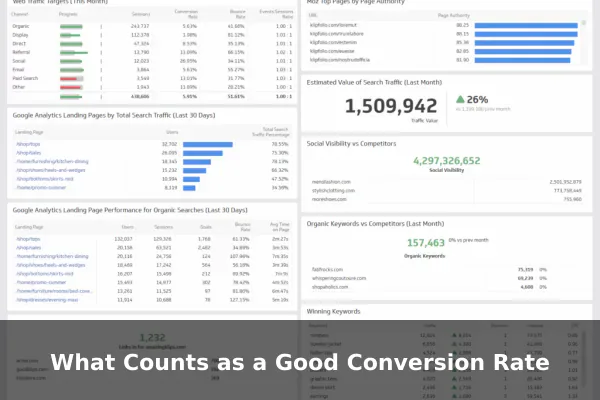
Rather than chasing an external number, the U.S. Small Business Administration encourages small businesses to compare current performance against their own baseline and against the cost of acquiring that traffic. Useful guardrails include:
- Trend over time: is the rate improving month over month for the same audience and channel?
- Segment performance: how do paid, organic, email, and referral compare?
- Device and geography: mobile and desktop often perform very differently and should be reviewed separately.
- Revenue per visitor: a lower rate on higher-value buyers can outperform a higher rate on smaller orders.
Benchmarks published by analytics vendors can be useful as rough context, but treat any single industry average cautiously — methodologies and sample sets vary.
How to Improve Your Conversion Rate
Conversion rate optimization (CRO) is a disciplined process of forming hypotheses, testing changes, and measuring impact. The following levers consistently appear in vendor documentation and case studies.
Reduce Friction in the Path
- Shorten forms to the fields you genuinely need.
- Offer guest checkout for first-time buyers.
- Pre-fill known information for returning users.
- Improve page load speed, especially on mobile.
Sharpen the Message-Match
Visitors who clicked a specific ad should land on a page that mirrors the ad’s promise. Mismatched headlines and offers are a leading cause of weak conversion performance.
Strengthen the Call to Action
- Use clear, action-oriented button text such as Start Free Trial instead of generic Submit.
- Place the primary CTA above the fold and repeat it after key content blocks.
- Limit the number of competing actions on a single page.
Run Controlled A/B Tests
Compare a single change against a control with enough traffic to reach statistical significance. Random changes without measurement can inflate or hide real effects. Document each test so the team builds a library of what works.
Maintain Measurement Hygiene
Reliable improvements depend on reliable data. Audit your tracking regularly to confirm that conversion events fire correctly, exclude bot and internal traffic, and align definitions across teams. Without this foundation, you may be optimizing against noise.
Conclusion
Conversion rate is a deceptively simple metric: conversions divided by total interactions, multiplied by one hundred. The real skill lies in choosing the right numerator and denominator, applying the formula consistently across channels, and reading the result with context — industry, intent, device, and funnel stage all matter. When teams agree on definitions and instrument their tracking with care, conversion rate becomes a trustworthy compass for marketing investment and product decisions.
Use the worked examples in this guide as templates, anchor your conversion definitions to authoritative documentation from Google Analytics, HubSpot, Adobe Analytics, the American Marketing Association, and the U.S. Small Business Administration, and treat benchmarks as directional rather than absolute. Improve the number through disciplined testing rather than guesswork, and conversion rate will quietly become one of the most useful metrics in your marketing toolkit.
Official references
- Google Analytics Help – Conversions (support.google.com) – Official Google documentation defining conversions, conversion rate calculation, and tracking methodology used across the marketing industry.
- HubSpot Academy – Marketing Glossary (hubspot.com) – Official HubSpot reference pages on conversion rate definitions and formulas from a primary marketing platform vendor.
- Adobe Analytics Documentation – Conversion Metrics (experienceleague.adobe.com) – Official Adobe product documentation explaining how conversion rate is computed in enterprise analytics.
- U.S. Small Business Administration – Government resource providing authoritative guidance on small business marketing metrics and performance measurement.
- American Marketing Association – Leading professional marketing organization providing authoritative definitions of marketing metrics including conversion rate.
