
Marketing often looks more complicated than it really is. Busy readers are usually exposed to isolated advice such as post more on social media, run ads, improve SEO, or build a better brand, but those tips rarely explain how the pieces fit together. That is why the most useful marketing knowledge is not a long glossary of terms. It is a small set of ideas that helps you make better decisions quickly.
Essential Marketing Knowledge Points for Busy Readers is best understood as a practical mental model. Marketing is the process of understanding demand, creating value, communicating that value clearly, and guiding people toward action. When you see marketing this way, many tactics become easier to evaluate. You stop chasing noise and start asking better questions about audience, message, channel, timing, and results.
This article focuses on the few marketing knowledge points that influence most real-world decisions. Instead of diving deep into one channel or one formula, it shows how the core ideas connect. If you are short on time and want a simple framework you can remember, this guide will give you the structure behind effective marketing without burying you in jargon.
What Marketing Actually Does in a Business
Many people reduce marketing to promotion, but that is only one part of the job. Good marketing helps a business understand who it serves, what problem it solves, why its offer matters, and how to reach the right people at the right moment. In other words, marketing is not just about getting attention. It is about turning attention into relevance, trust, and action.
Marketing connects the market to the offer
A business can have a strong product and still struggle if the market does not understand it. Marketing translates what the business makes into language the customer cares about. It identifies the gap between what a company wants to say and what a buyer actually needs to hear.
That translation matters because customers do not buy features in isolation. They buy outcomes, reduced risk, convenience, status, speed, confidence, savings, or relief from frustration. Marketing identifies which of those outcomes matters most and makes it visible.
Marketing supports both short-term action and long-term growth
Another essential point is that marketing works on two time horizons at once. In the short term, it can generate traffic, leads, and sales. In the long term, it shapes memory and preference so that future buying decisions become easier. A business that ignores the first horizon may run out of revenue. A business that ignores the second may become dependent on constant discounting or heavy ad spend.
- Attract attention: Help the right people notice the offer.
- Shape perception: Influence what people believe about quality, fit, and credibility.
- Create demand: Show why the problem matters and why action should happen now.
- Support retention: Keep customers engaged after the first purchase.
For busy readers, the simplest takeaway is this: marketing exists to reduce the distance between customer need and business value.
Know the Audience Before Choosing Any Tactic
One of the most common reasons marketing underperforms is simple: teams choose tactics before they understand the audience. They decide to launch a newsletter, post on every platform, or buy ads before answering basic questions about who they are trying to influence and why those people should care.
Problems matter more than demographics alone
Demographic details can be helpful, but they are rarely enough. Knowing that your buyer is between 30 and 45 years old does not explain what motivates action. Strong marketing starts with the audience’s pain points, desired outcomes, objections, habits, and triggers. A clear picture of the customer’s job to be done will outperform a vague profile every time.
For example, two customers with similar incomes may buy for completely different reasons. One may care about saving time. Another may care about reducing risk. Another may want social proof before making any decision. If your message ignores those differences, the campaign may attract clicks without creating real intent.
Buying context shapes channel choice
The audience also determines where marketing should happen. A person researching business software behaves differently from someone impulse-buying a low-cost product. A high-consideration purchase may require search, case studies, email follow-up, and demos. A simpler purchase may respond well to short-form content, reviews, or a well-timed paid offer.
Before picking channels, ask:
- What problem is the buyer trying to solve?
- How urgent is that problem?
- What information reduces hesitation?
- Where does this person look for ideas, proof, or comparisons?
- What would make the next step feel easy and low risk?
This is one of the most important marketing knowledge points for busy readers: audience clarity saves time. It prevents wasted content, weak targeting, and irrelevant messaging.
Value Proposition Comes Before Promotion
Promotion cannot rescue a weak or unclear offer. Many marketing efforts fail because the business is trying to amplify a message that is not compelling in the first place. Before asking how to get more reach, ask whether the value proposition is easy to understand.
A value proposition answers the buyer’s unspoken question
That question is usually: Why should I choose this instead of doing nothing or choosing something else? A strong value proposition gives a fast, credible answer. It explains the outcome, the difference, and the reason to believe.
In simple terms, an effective value proposition usually contains three elements:
- Who it is for: The audience or use case.
- What benefit it delivers: The result the buyer wants.
- Why it is meaningfully different: The feature, method, proof, or positioning that makes the offer stand out.
Clarity usually beats cleverness
Busy readers should remember that people rarely reward vague marketing. Clever phrases may sound interesting internally, but buyers respond better to language that quickly reduces confusion. If a visitor cannot understand your offer in a few seconds, more promotion may simply multiply wasted traffic.
Clear value propositions also improve downstream performance. They make ads easier to write, landing pages easier to structure, sales conversations easier to start, and customer expectations easier to manage.
Questions that reveal a weak offer
If you are unsure whether the value proposition is strong enough, test it with these questions:
- Can a new visitor explain the offer after a short glance?
- Does the message focus on benefits, not just internal language?
- Is there a believable reason to trust the claim?
- Would the audience notice a real difference from alternatives?
Promotion works best when it is amplifying something already valuable and easy to understand.
The Core Marketing Funnel in Simple Terms
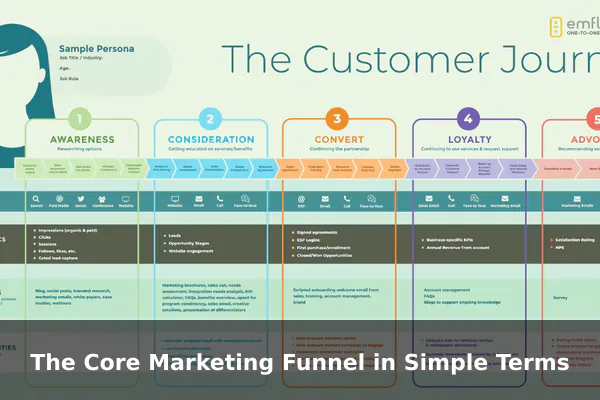
One of the most useful frameworks for time-constrained readers is the marketing funnel. It is not perfect, and real buying behavior is rarely linear, but it remains a practical way to organize marketing efforts. The funnel helps you see that different stages require different messages, assets, and success metrics.
Awareness
At the top of the funnel, the goal is visibility. People may not know your brand, your category, or even the problem you solve. Marketing at this stage focuses on reaching relevant audiences and making the first impression easy to remember. Useful formats include educational content, search visibility, social discovery, partnerships, and broad-reach campaigns.
The mistake here is pushing for conversion too early. If the audience has little context, hard selling may create friction instead of progress.
Consideration
Once people become aware, they begin evaluating options. This stage is about helping them compare, understand, and trust. Case studies, product pages, demos, testimonials, FAQs, reviews, webinars, and comparison content all support consideration. The message shifts from look at us to here is why this may fit your needs.
Conversion
At the conversion stage, the prospect is close to acting. Small details matter a lot here. Pricing clarity, checkout simplicity, call-to-action strength, lead form friction, response speed, and risk-reduction signals all influence results. Good conversion marketing removes obstacles rather than adding extra persuasion.
Retention and advocacy
Many teams treat the funnel as ending at the sale, but that is a costly mistake. Retention increases customer value, lowers pressure on acquisition, and creates better word-of-mouth. Advocacy turns satisfied customers into proof for future buyers. Onboarding, lifecycle email, community, support quality, and referral design all matter after the first transaction.
A practical funnel summary looks like this:
- Awareness: Help the right people notice you.
- Consideration: Help them understand and compare.
- Conversion: Help them act with confidence.
- Retention: Help them succeed after purchase.
- Advocacy: Help them share positive experiences.
If results are weak, ask which stage is broken. That question is often more useful than asking which tactic is trendy.
The Main Channels Every Reader Should Recognize
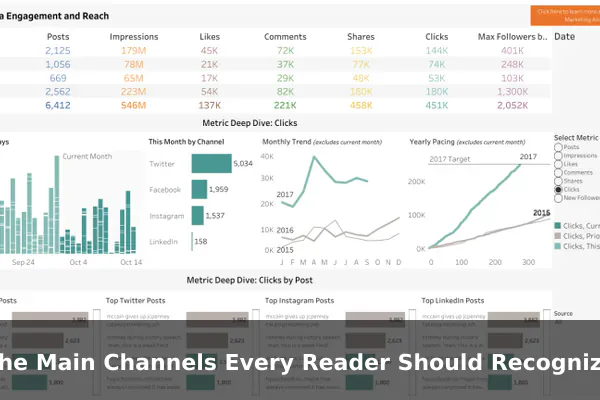
You do not need to master every marketing channel to make sound decisions. You do need to understand what each channel is good at, where it tends to struggle, and how it fits into the customer journey. Busy readers benefit from recognizing the role of major channels rather than trying to memorize endless platform-specific advice.
Content and SEO build discoverability over time
Content marketing and SEO are strong when buyers actively search for information, answers, or solutions. They can attract intent-driven visitors, educate prospects, and build authority. Their main advantage is compounding value: useful content can keep working after publication. Their main limitation is speed. They usually take time to build momentum.
Email works best as a relationship channel
Email is often misunderstood as a pure promotion tool. In reality, its greatest value is continuity. It helps nurture interest, recover abandoned opportunities, onboard new customers, and maintain relevance over time. When messaging is segmented and timely, email can support both conversion and retention very efficiently.
Social media is powerful for attention and interaction
Social media channels are useful for reach, brand personality, community, and feedback loops. They can surface ideas quickly and make a business feel active and accessible. However, they are often weaker as a final conversion channel unless the offer is simple, impulsive, or strongly supported by proof.
Paid media creates speed and control
Paid search, paid social, display, and other ad formats are useful when a business needs immediate traffic, testing speed, or predictable reach. Paid channels are especially effective when the audience, offer, and conversion path are already reasonably clear. If those fundamentals are weak, paid media often exposes the weakness faster instead of solving it.
Word-of-mouth and referrals carry outsized trust
Not every important channel is purchased or owned. Recommendations, reviews, referrals, and customer advocacy often influence decisions more than polished campaigns do. They matter because trust transfers from one person to another. Strong products, reliable delivery, and memorable service make this channel much easier to activate.
A simple way to think about channels is this:
- Search-based channels: Capture existing intent.
- Social and content channels: Build attention and familiarity.
- Email and lifecycle channels: Deepen relationships and improve timing.
- Paid channels: Scale reach and test quickly.
- Referral channels: Leverage trust and customer satisfaction.
The best channel is not the most fashionable one. It is the one that matches the audience’s behavior and the offer’s buying pattern.
Brand and Performance Marketing Are Not the Same
Another essential marketing knowledge point is the difference between brand marketing and performance marketing. Many teams overcommit to one and neglect the other. That creates imbalance.
Brand marketing builds memory and preference
Brand marketing shapes how people feel about a business before they are ready to buy. It increases familiarity, trust, recognition, and mental availability. A strong brand makes future acquisition easier because the audience already has a reason to notice or remember you.
Brand effects are often less immediate, which is why impatient teams underinvest in them. But when competition rises, brand strength can reduce price pressure and improve conversion efficiency across channels.
Performance marketing focuses on measurable action
Performance marketing is designed to produce trackable outcomes such as leads, sales, sign-ups, or bookings. It is highly useful because it creates feedback quickly. You can often see which audience, creative, offer, or landing page drives better results.
The risk is becoming too short-term. If every decision is based only on immediate clicks or conversions, the business may stop building the reputation and differentiation that supports future demand.
Strong systems use both
Brand and performance are not enemies. They reinforce each other. Brand work improves response rates because the audience already recognizes the name or trusts the promise. Performance work reveals which messages and audiences are most responsive right now. Together, they help a business balance present revenue with future growth.
Busy readers can remember the distinction like this:
- Brand marketing: Makes more people willing to consider you.
- Performance marketing: Makes it easier to measure who acts now.
If a company feels invisible, brand may be too weak. If it feels popular but inefficient, performance discipline may be too weak.
Metrics That Matter More Than Vanity Numbers
Not all numbers deserve equal attention. One of the most useful marketing knowledge habits is learning to separate informative metrics from flattering ones. Traffic, impressions, likes, and follower counts can be useful context, but they do not automatically prove business impact.
Efficiency metrics show whether acquisition is sustainable
Metrics such as conversion rate, cost per lead, customer acquisition cost, and return on ad spend help measure efficiency. They answer practical questions: How much friction exists in the path to action? How expensive is growth? Is paid media generating enough value relative to cost?
These metrics are helpful because they connect marketing activity to economic reality. A campaign that brings large traffic but poor conversion may look active while actually destroying efficiency.
Quality metrics reveal whether growth is healthy
Volume is not the same as quality. A business should also examine lead quality, purchase value, repeat purchase behavior, retention, churn, and customer lifetime value. These numbers show whether the acquired audience is worth keeping and whether the business model can support scaling.
Use metric pairs instead of isolated numbers
Single metrics can mislead when viewed alone. It is usually smarter to read them in pairs:
- Traffic plus conversion rate: Shows whether visibility turns into action.
- Acquisition cost plus lifetime value: Shows whether customer economics are attractive.
- Open rate plus click rate: Shows whether email interest leads to deeper engagement.
- Revenue plus retention: Shows whether today’s growth is durable.
The core lesson is simple: choose metrics that reflect movement through the funnel and contribution to business value. Vanity numbers may boost confidence, but they rarely improve decisions on their own.
Why Testing Beats Guesswork
Marketing includes creativity, but effective marketing is not random. It improves through structured learning. Testing matters because even experienced teams are often wrong about which headline, offer, audience, or format will perform best.
What to test first
Busy teams should begin with high-leverage variables, not endless small tweaks. Start with the parts most likely to affect outcomes:
- The promise in the headline.
- The audience segment being targeted.
- The offer or incentive.
- The landing page structure and call to action.
- The creative angle or proof element.
These tests matter more than minor color changes or decorative edits. A strong offer with clear proof usually beats a prettier page with weak positioning.
Good testing requires discipline
Testing is only useful when the team changes a limited number of variables and gives the result enough time or volume to mean something. Constantly changing everything at once creates noise, not learning. The goal is not to prove your first idea right. The goal is to understand what the market responds to.
Testing creates organizational knowledge
One overlooked benefit of testing is that it builds a memory system for the business. Over time, repeated experiments reveal which messages resonate, which channels are efficient, which objections hurt conversion, and which customer segments create the best outcomes. That accumulated learning is one of the most valuable assets a marketing team can have.
When in doubt, test before scaling. Guesswork feels fast, but disciplined testing usually saves more time and budget in the long run.
Common Marketing Mistakes Busy Teams Make
When time is limited, teams often default to activity that feels productive without checking whether it is strategically sound. That creates a predictable set of mistakes.
Chasing channels before clarifying the message
A business may expand into new platforms because competitors are there or because a tactic seems popular. But channel expansion rarely fixes weak positioning. If the message is generic, moving it to five places instead of one just spreads the weakness faster.
Confusing attention with progress
More traffic, more views, and more social activity can be useful, but they do not guarantee better business results. Attention matters only when it attracts the right audience and leads to meaningful next steps. Otherwise, teams may celebrate volume while revenue quality stays flat.
Ignoring retention while obsessing over acquisition
Acquiring new customers is exciting, so many teams put most of their energy there. But weak onboarding, poor follow-up, and inconsistent customer experience can erase the value created by acquisition. Growth is more stable when retention improves alongside acquisition.
Using inconsistent messaging across touchpoints
If the ad promises one thing, the landing page says another, and the sales conversation emphasizes something else, trust erodes. Consistency is not repetition for its own sake. It is alignment around the core value proposition so buyers do not feel confused as they move through the journey.
Skipping measurement because the stack feels complex
Some teams avoid measurement because dashboards, attribution, and reporting feel overwhelming. The solution is not perfect complexity. It is a simple tracking structure tied to a few meaningful business outcomes. Clear measurement beats sophisticated confusion.
A fast mistake-check list:
- Are we solving a real audience problem or just publishing activity?
- Is our message clear enough to repeat across channels?
- Are we focusing on one or two priorities instead of everything at once?
- Do our metrics reflect quality, not just volume?
- Are we learning from tests or just reacting emotionally to results?
A Simple Marketing Checklist to Apply Right Away
If you only remember one section from this article, make it this one. The point of essential marketing knowledge is not memorizing terminology. It is making faster, better decisions. Use this checklist whenever you review a campaign, product launch, or ongoing marketing plan.
- Define the audience clearly. Name the specific group, the problem they feel, and the outcome they want.
- State the value proposition in plain language. Make sure a new visitor can understand what you offer and why it matters.
- Match the channel to buyer behavior. Use channels based on where the audience actually discovers, researches, and decides.
- Map the funnel. Identify what should happen at awareness, consideration, conversion, and retention stages.
- Align the message across touchpoints. Keep the core promise consistent from ad to page to follow-up.
- Choose a small set of meaningful metrics. Track efficiency, quality, and retention, not just attention.
- Test one important variable at a time. Learn systematically instead of changing everything at once.
- Review customer experience after the sale. Retention, referrals, and repeat value often create the strongest compounding effects.
- Balance brand and performance. Build present demand while also strengthening future preference.
- Keep simplifying. If the strategy feels crowded, remove what does not support the main objective.
This checklist works because it turns broad marketing knowledge into a usable operating routine. It helps busy readers move from scattered ideas to structured judgment.
Conclusion
The most important marketing knowledge points are not isolated definitions. They are the core ideas that help you evaluate nearly every tactic: know the audience, sharpen the value proposition, understand the funnel, choose channels based on behavior, balance brand and performance, measure what matters, and test before scaling. When these foundations are clear, marketing becomes easier to understand and easier to improve.
For busy readers, the real advantage is not learning more terms. It is gaining a decision framework. That is what makes Essential Marketing Knowledge Points for Busy Readers useful as more than a title. It becomes a way to filter noise, focus on what drives results, and build marketing that is both practical and sustainable.
