

Most marketing campaigns fail not because the creative was poor, but because they tried to speak to everyone and ended up connecting with no one. A spray-and-pray approach wastes budget, dilutes your message, and makes it nearly impossible to measure what actually works. The solution starts with one foundational question: who, exactly, are you selling to?
A target market is the specific group of people your product or service is designed for — the consumers most likely to need what you offer, have the ability to pay for it, and respond to your marketing. Defining your target market clearly is one of the highest-leverage activities a marketer or business owner can do. It focuses your spending, sharpens your messaging, and dramatically improves the odds that the right person sees the right offer at the right time.
What Is a Target Market?
A target market is a defined segment of consumers that a business directs its products, services, and marketing efforts toward. It sits within the larger total addressable market (TAM) — the entire pool of potential buyers — but is far more specific and actionable.
For example, a fitness equipment company might have a TAM of all adults worldwide, but its target market might be health-conscious adults aged 25–45 who exercise at home and have a household income above $60,000. The target market is where the business concentrates its resources because that group is most likely to convert.
Defining a target market means answering three core questions:
- Who is most likely to buy this product or service?
- What problems does it solve for them?
- Where do they spend time and how do they make purchase decisions?
A well-defined target market is not a permanent label. It is a working hypothesis that evolves as the business grows and real customer data accumulates.
Target Market vs. Target Audience: Key Differences
These two terms are frequently used interchangeably, but they carry distinct meanings that matter in practice.
- Target market refers to the broader group of consumers a business builds its entire product and go-to-market strategy around. It is a strategic, long-term definition.
- Target audience refers to the specific subset of people a particular campaign, ad, or piece of content is directed at. It is tactical and campaign-specific.
Think of it this way: a skincare brand’s target market might be women aged 18–40 who prioritize natural ingredients. For a specific Instagram campaign promoting a new sunscreen, the target audience might narrow further to women aged 22–30 living in sunny climates who follow wellness influencers.
Your target market stays relatively stable across quarters and years. Your target audience shifts with each campaign, channel, message, and seasonal promotion. Both definitions are necessary — but they serve different planning purposes.
The Four Main Types of Market Segmentation
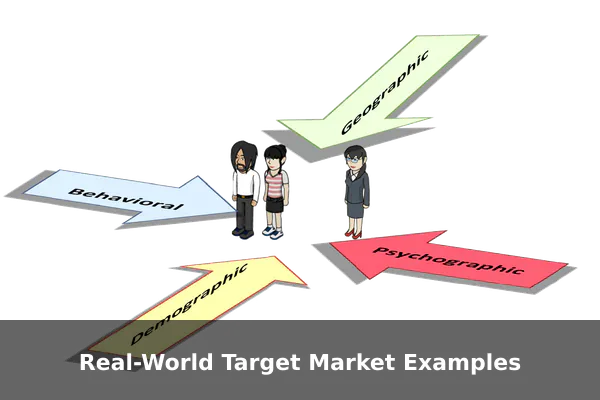
Segmentation is the process of dividing a broad market into smaller, more manageable groups. Understanding which segmentation types apply to your business is essential before you can define your target market with precision.
Demographic Segmentation
Based on measurable characteristics such as age, gender, income, education, occupation, and family status. This is the most commonly used segmentation type because the data is widely available and easy to apply. Example: a luxury stroller brand targeting first-time parents with household incomes above $80,000.
Geographic Segmentation
Based on location: country, city, region, climate zone, or urban versus rural setting. Geography influences purchasing behavior more than many marketers realize. Example: a snow removal service targeting homeowners in northern U.S. states with significant annual snowfall.
Psychographic Segmentation
Based on values, lifestyle choices, interests, attitudes, and personality traits. This goes deeper than demographics by capturing why people buy, not just who they are. Example: an eco-friendly clothing brand targeting consumers who actively prioritize sustainability and ethical sourcing in every purchase decision.
Behavioral Segmentation
Based on actual purchase behavior, brand loyalty, usage frequency, and buying stage. This is often the most predictive segmentation type. Example: a coffee subscription service targeting daily coffee drinkers who have previously abandoned a competitor’s subscription within the past six months.
Most businesses use a combination of two or more segmentation types to build a precise, actionable target market definition rather than relying on a single dimension alone.
Real-World Target Market Examples
Seeing how established brands define their target markets makes the concept concrete and easier to apply to your own business.
Nike Running Shoes
Nike’s broader market encompasses athletes and fitness enthusiasts of all kinds, but for its performance running shoe line, the target market is runners aged 18–40 who train at least three times per week, track performance metrics, and are willing to pay a premium for technology-driven footwear. Every product feature, ad, and sponsorship decision flows from this definition.
Duolingo
Duolingo targets casual language learners aged 16–35 who want to study a new language on a flexible, mobile-first schedule without paying for traditional classroom instruction. Psychographically, they are self-motivated, enjoy gamified learning, and respond to humor and social comparison features. The app’s entire design — streaks, leaderboards, casual tone — reflects this market profile precisely.
BMW
BMW targets high-income professionals aged 30–55 who value engineering excellence, driving performance, and social status. Their messaging rarely focuses on price. It focuses on the experience of driving, the identity associated with ownership, and the craftsmanship of the vehicle — signals that resonate with that specific buyer psychology and no one else’s.
In each case, the brand’s messaging, pricing, distribution channels, and creative choices flow directly from a clear target market definition. When the market is well-defined, every strategic decision becomes easier and more consistent.
How to Define Your Target Market in 5 Steps
Defining a target market is not a guessing exercise. Here is a repeatable, data-driven process any business can follow:
- Analyze your existing customers. Who is already buying from you? Look at age, location, occupation, purchase frequency, and average order value. Your best customers reveal patterns worth replicating and targeting more intentionally.
- Research your competitors. Who are your direct competitors targeting? Are there underserved segments they consistently ignore? Competitive gaps often reveal market opportunities worth pursuing before they become crowded.
- Identify core pain points. What specific problem does your product or service solve? The more precisely you can describe the pain, the more precisely you can describe who experiences it. Pain is the thread that connects product to market.
- Build a basic customer persona. Combine your data into one or two representative profiles. Include demographics, psychographics, goals, and frustrations. A persona is a communication and alignment tool — every detail should be evidence-based, not invented from assumptions.
- Test, measure, and refine. Run campaigns targeting your defined market. Monitor performance by segment. Use real data to adjust who you target, what you say, and where you show up. Expect your initial hypothesis to change as real results come in.
Target markets are not static. A startup’s initial market hypothesis almost never matches what the data shows after 12 months of actual selling. Build in quarterly or annual reviews to test whether your assumptions still hold.
Tools and Data Sources for Market Research
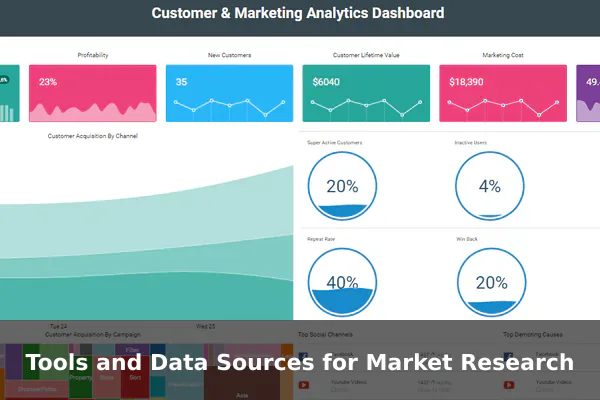
You do not need a large research budget to gather meaningful market data. These tools are widely used and accessible at any business stage:
- Google Analytics — Reveals who visits your website by age, gender, location, device, and interest categories, giving you a real picture of who your content already attracts.
- Meta Audience Insights — Provides demographic and interest data about Facebook and Instagram users relevant to your business category and existing page followers.
- Google Trends — Shows relative search interest over time for terms related to your product, segmented by region, helping you spot geographic and seasonal demand patterns.
- Customer surveys (Typeform, Google Forms) — Direct feedback from existing customers about why they chose you, what they value most, and what nearly stopped them from buying.
- Social listening tools (Brandwatch, Mention) — Track what people say online about your category: complaints, feature requests, and the exact language customers use to describe their own problems.
- Industry reports (Statista, IBISWorld) — Aggregated market data useful when entering a new product category or validating market size assumptions with third-party sources.
The strongest target market definitions combine quantitative data — who, how often, how much — with qualitative insight — why they buy, what they believe, and what they fear. Neither alone is sufficient for reliable strategy.
Common Mistakes When Choosing a Target Market
Even experienced marketers fall into these patterns. Recognizing them early saves significant time and budget.
Targeting Too Broadly
Everyone is not a target market. Broad targeting forces generic messaging that resonates with no one deeply. Narrowing your defined market does not shrink your revenue potential — it focuses it. A tighter market definition typically improves conversion rates and customer lifetime value at the same time.
Relying on Assumptions Instead of Data
The most common mistake is building a target market profile based on who the founder believes will buy, rather than who actually does. Let customer behavior — purchases, clicks, referrals, support requests — define the market. Assumptions are a starting point, not a final answer.
Never Revisiting the Definition
Markets change. Consumer behavior shifts. A target market defined in 2020 may no longer describe who is buying in 2025. Build in regular reviews — at minimum annually — to test whether your assumptions still match observable customer behavior and emerging trends.
Confusing Aspiration with Reality
A brand might want to attract luxury buyers but actually sells mostly to mid-market consumers. Building strategy around an aspirational market rather than the real one leads to misaligned messaging, wasted media spend, and products that do not reflect what paying customers actually want.
Conclusion
Defining your target market is not a one-time task — it is a continuous discipline that sits at the core of effective marketing. When you know precisely who you are speaking to, every dollar you spend works harder, every message lands more clearly, and every campaign produces more measurable results. Start with the data you already have, apply the segmentation frameworks above, and revisit your definition regularly as your business and market evolve. The clarity you gain will shape everything from product development to channel selection to the exact words you choose in a headline.
