
Most marketers are not short on knowledge — they are short on application. Between podcasts, newsletters, online courses, and conference talks, the average marketing professional encounters hundreds of new ideas every month. Yet most of those ideas never make it past the browser tab they were opened in.
The gap between absorbing marketing knowledge and actually using it is where business value disappears. The good news is that this gap is not a talent problem — it is a systems problem. With the right habits and frameworks in place, you can turn the marketing information you already consume into measurable results for your business.
Why Most Marketing Knowledge Goes to Waste
The Information Overload Trap
Consuming content feels productive, but it rarely is. Scrolling through marketing newsletters, watching tutorial breakdowns, and jumping between courses creates a sense of progress without any real movement. The volume of available marketing information has exploded, and so has the tendency to mistake consumption for competence.
No System, No Retention
Without a reliable way to organize and revisit information, knowledge fades fast. Research consistently shows that people forget the majority of new material within days unless they actively revisit and apply it. Most marketers have no organized place where concepts can be stored, linked, and retrieved when needed — no structure to make learning stick.
The Missing Execution Loop
Reading about a tactic is not the same as running one. A framework only becomes useful when it is tested against a real audience with real constraints. Without a clear path from concept to action, marketing knowledge stays theoretical — interesting to think about, but invisible to the business.
Build a Personal Marketing Knowledge System
The single highest-leverage thing you can do to extract more value from marketing knowledge is to build a personal system for organizing and retrieving it. This does not need to be complicated — it needs to be consistent.
Categorize by Topic and Use Case
Organize your notes and saved content by channel, goal, or audience type — not by the source where you found them. More importantly, tag each piece of knowledge with a practical label: “when would I use this?” A tactic for improving email open rates belongs under a different category than a framework for positioning a new product launch.
Choose Tools You Will Actually Use
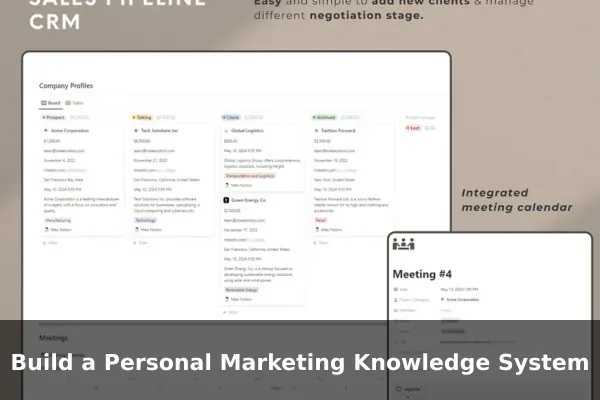
The best knowledge management system is the one you maintain consistently. Notion works well for those who like structured databases. A simple swipe file — a folder of screenshots and saved links organized by topic — works equally well. Pick one approach and commit to it rather than cycling through new tools every few months.
Set a Weekly Review Cadence
- Block 15–20 minutes per week to revisit your saved notes and ideas
- Ask yourself: what from last week’s learning can I test this week?
- Archive concepts that are no longer relevant so your system stays lean and usable
Apply Knowledge Through Small Experiments
The fastest way to convert marketing knowledge into real skill is to test it — not in a massive campaign, but in a controlled, low-risk experiment designed to teach you something specific.
Test One Tactic at a Time
Running one small experiment at a time lets you isolate what actually drives results. Large campaigns involve too many variables to learn from clearly. A small test — one subject line variation, one new ad format, one adjusted call-to-action — gives you a clean signal. That signal is where the real learning happens.
Build a Simple Feedback Loop
Before starting any experiment, define what success looks like. Record the hypothesis, the action you took, and the outcome in a simple log. Even a basic spreadsheet works. Over time, this log becomes a personal marketing playbook specific to your audience, your brand, and your business context — far more valuable than any generic course or framework.
Turn Passive Learning Into Active Skills
Teach What You Learn
One of the most effective ways to internalize a marketing concept is to explain it to someone else. Teaching forces clarity. When you put an idea into plain language for a colleague or a team meeting, you quickly discover where your understanding has gaps — and where it is genuinely solid. Even writing a brief internal summary or a short message explaining a new tactic to your team counts as active recall.
Create Templates From Frameworks
When you learn a framework — a messaging matrix, a content audit checklist, a positioning canvas — convert it into a reusable document immediately. Templates encode knowledge into a form you can deploy on demand. Instead of re-reading the same article every time you need to apply a concept, you pull up the template and work directly from it, saving time and reinforcing the underlying idea.
Connect Knowledge to Business Goals
Map Every Concept to a KPI
Before applying any marketing idea, ask one question: which metric does this move? If you cannot answer that clearly, the knowledge is not ready to act on yet. Tying concepts directly to specific KPIs — conversion rate, cost per lead, organic traffic, customer retention — keeps your learning grounded in what your business actually needs rather than what is theoretically interesting.
Filter for Relevance, Not Novelty
The most exciting marketing trend is rarely the most useful one right now. New tactics compete for your attention constantly, but the return on applying a well-understood strategy correctly almost always outperforms chasing the latest platform update or algorithm change. Run new knowledge through the filter of your current business priorities before adding it to your active learning queue.
Stay Current Without Getting Overwhelmed
Curate a Short, High-Quality Source List
Limit your ongoing marketing education to three to five trusted sources per channel — whether that means newsletters, podcasts, or professional communities. Unsubscribe aggressively from anything that generates noise without genuine insight. A smaller, higher-quality input list means less time sorting and more time applying what you learn.
Set Fixed Learning Blocks
Treat learning like any other work task by scheduling dedicated time for it each week. Even 30 focused minutes per week, applied consistently, compounds into a meaningful advantage over 12 months. Keeping learning time separate from execution time prevents the two from competing — and ensures that neither gets dropped when work gets busy.
Conclusion
Marketing knowledge is only as valuable as what you do with it. The marketers who get the best results from their education are not necessarily the ones who consume the most — they are the ones who apply the most deliberately. By building a simple personal system, running small experiments, and mapping every concept back to a real business goal, you close the gap between knowing and doing. That gap is exactly where most marketers fall short — and exactly where a structured approach lets you pull ahead.
