
B2B marketing is how companies promote their products or services to other businesses. Unlike consumer marketing, B2B (business-to-business) marketing targets purchasing managers, executives, procurement teams, and other decision-makers who buy on behalf of an organization.
The buying process in B2B is longer, more deliberate, and involves multiple stakeholders. A single sale can take weeks or months and require buy-in from several departments. That complexity shapes every part of B2B marketing—from the messages you write to the channels you use. This article explains what B2B marketing means, how to build a basic strategy, and what it looks like in practice.
B2B Marketing Defined
B2B marketing is the process of promoting products or services from one business to another. The goal is to attract, engage, and convert business buyers into paying customers.
Business buyers have specific needs. They care about efficiency, ROI, compliance, and how a solution fits into their existing workflows. B2B marketers address those priorities through targeted content, case studies, product demos, and direct outreach rather than broad-appeal advertising.
Common B2B sellers include software companies (SaaS), manufacturers, logistics providers, marketing agencies, and professional service firms. Virtually any business that sells to other businesses practices B2B marketing in some form.
How B2B Marketing Differs From B2C
Audience and Buying Process
In B2C (business-to-consumer) marketing, you are persuading one person. In B2B, you are typically influencing a buying committee of three to ten people across different roles and departments. Each stakeholder has different concerns, and your messaging must address them all.
B2B purchases are driven by logic, documented business outcomes, and internal approval processes. B2C purchases are often driven by emotion, convenience, and personal preference. That difference changes tone, format, and the type of evidence required to close a deal.
Sales Cycle and Deal Value
B2B sales cycles are far longer—ranging from weeks to months or even years for enterprise contracts. Deal values are also significantly higher, which is why B2B marketing invests heavily in relationship-building and education rather than impulse-driving tactics. The longer a cycle, the more trust your marketing must build before a buyer is ready to talk to sales.
Core Elements of a B2B Marketing Strategy
Ideal Customer Profile and Buyer Personas
An ideal customer profile (ICP) describes the type of company most likely to buy and succeed with your product—defined by industry, company size, revenue, geography, and technology stack. Buyer personas go deeper, describing the individual roles within that company (such as IT Manager, CFO, or Marketing Director) and what each person cares about when making purchasing decisions.
Value Proposition and Messaging
Your value proposition explains what you offer, who it is for, and why it is better than alternatives. B2B messaging must be specific and outcome-focused. A statement like “Save 20 hours per week on reporting” is far more compelling than “Powerful analytics platform.” Specificity builds credibility with buyers who need to justify purchases internally.
Funnel Stages and Sales Alignment
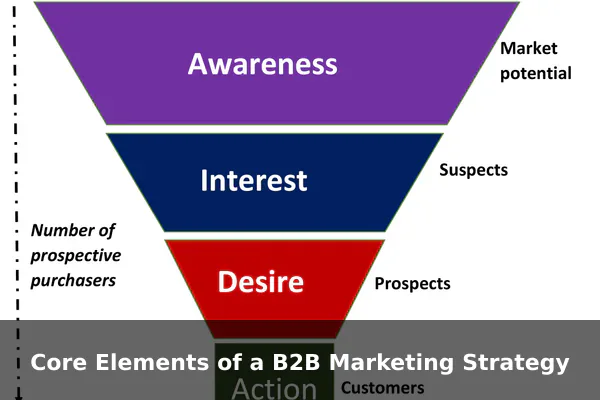
B2B marketing maps to three funnel stages: awareness (top), consideration (middle), and decision (bottom). Each stage calls for different content, channels, and offers. Critically, marketing and sales teams must align on when a lead becomes sales-ready and how to hand it off cleanly to avoid leads falling through the cracks.
Most Effective B2B Marketing Channels
The right channel depends on your audience, budget, and growth stage. These are the most consistently effective channels for B2B companies:
- Content marketing: Blog posts, whitepapers, and guides that attract organic traffic and establish category authority.
- SEO: Ranking for terms that business buyers search when researching solutions, vendors, or comparisons.
- Email marketing: Nurturing leads with relevant, well-timed content to move them through the funnel without requiring sales involvement at every touchpoint.
- LinkedIn: The dominant social platform for B2B, effective for outreach, paid ads, and thought leadership from company leaders.
- Webinars and virtual events: High-trust formats that demonstrate expertise and generate qualified leads who have already invested time.
- Account-based marketing (ABM): Highly targeted campaigns aimed at a defined list of high-value accounts, often coordinating marketing and sales efforts together.
- Paid advertising: Google Ads or LinkedIn Ads to capture demand from buyers actively searching for solutions or to reach specific job titles at target companies.
Examples of B2B Marketing in Action
SaaS Company
A project management software company uses SEO-driven blog content to attract decision-makers searching for terms like “best project management tool for remote teams.” A free trial offer combined with an onboarding email sequence nurtures those leads into paying customers without requiring a sales call for smaller plans.
Manufacturing Supplier
An industrial parts supplier targets procurement managers at factories. Their marketing mix includes a detailed product catalog, LinkedIn ads aimed at procurement roles, and a sales team that follows up after form submissions. Industry trade shows also generate high-quality leads in this sector where relationships matter.
Marketing Agency
An agency targeting e-commerce brands publishes detailed case studies showing measurable revenue outcomes from past campaigns. Cold email outreach to heads of marketing opens conversations, while LinkedIn retargeting keeps the agency visible to website visitors who did not convert initially.
How to Measure B2B Marketing Success
B2B marketing success is measured by pipeline impact, not just lead volume. The metrics that matter most include:
- Marketing Qualified Leads (MQLs): Leads that match your targeting criteria and show sufficient engagement to be worth sales attention.
- Sales Qualified Leads (SQLs): MQLs that sales has reviewed, accepted, and begun actively pursuing.
- Pipeline generated: Total deal value attributed to marketing efforts, giving revenue teams a forward-looking indicator.
- Customer Acquisition Cost (CAC): Total marketing and sales spend divided by the number of new customers won in a period.
- Conversion rate: The percentage of leads that progress from one funnel stage to the next, revealing where drop-off occurs.
- Marketing ROI: Revenue generated from campaigns relative to what was spent, the ultimate efficiency metric.
Common B2B Marketing Mistakes to Avoid
Even experienced teams fall into these avoidable traps:
- Targeting too broadly: Reaching companies that will never buy wastes budget and inflates lead counts with noise.
- Generic messaging: Saying “we help businesses grow” tells buyers nothing. Be specific about what outcomes you deliver and for whom.
- Poor sales alignment: Marketing generating leads that sales ignores is a systemic failure. Both teams must agree on what a qualified lead looks like.
- Prioritizing quantity over quality: One thousand random leads are worth far less than fifty highly targeted MQLs from your ideal customer profile.
- Neglecting existing customers: In B2B, significant revenue comes from upsells, expansions, and renewals—not only new customer acquisition.
When a B2B Marketing Plan Is Working
Strong B2B marketing shows up in consistent pipeline growth, shorter sales cycles, and improving win rates. Sales and marketing agree on what a good lead looks like. Content attracts the right buyers at the right stage of their decision process. Messaging resonates with documented pain points rather than assumed ones.
When qualified leads convert at a healthy rate and marketing investments are clearly tied to revenue outcomes, your B2B marketing strategy is on the right path. Building that foundation rarely happens overnight. B2B marketing rewards consistency, precise targeting, and strong alignment between every team involved in the go-to-market process.
Whether you are a startup building your first pipeline or an established company refining your strategy, the fundamentals stay constant: know your buyer deeply, speak to their specific needs, choose channels your buyers actually use, and measure outcomes that connect directly to revenue.
